




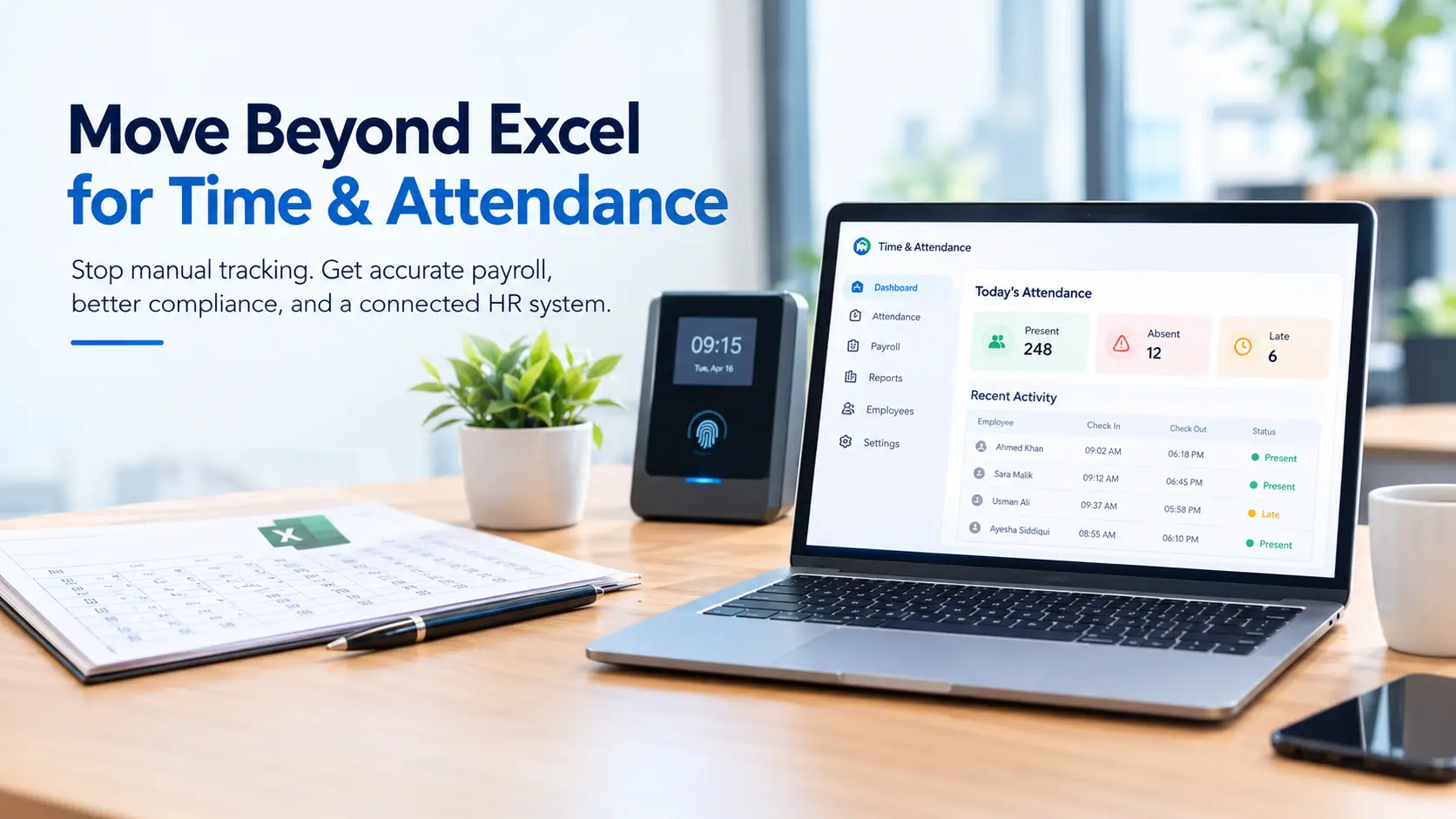
Companies still tracking time on Excel often move to time and attendance tracking software once payroll errors, missed punches, or manual reconciliation start costing more than the software itself. The strongest options are chosen using four criteria: payroll accuracy, implementation support, reporting depth, and integration breadth, rather than a feature checklist. Evaluating vendors against these four points helps HR teams pick software that solves the actual problem instead of adding another disconnected tool to an already complicated payroll process.
Excel worked when the company had twenty employees and one location. It doesn’t work anymore, not because the software changed, but because the business did. Multiple shifts, overtime rules, and a payroll cycle that now needs three extra days just to catch mistakes have turned attendance tracking into a monthly headache.
Most buying guides compare vendors by feature lists, geofencing, biometric scanners, and mobile clock-ins, without asking whether those features actually solve the problem. This guide uses a four-point framework instead: payroll accuracy, implementation support, reporting depth, and integration breadth. It’s built for HR leaders comparing time and attendance tracking software for the first time, not for teams that already know exactly which vendor they want.
Manual Tracking Breaks Quietly, Then All At Once
Spreadsheets don’t flag errors; they record whatever gets typed into them. A missed clock-out becomes a payroll dispute weeks later. A formula that breaks when a row shifts goes unnoticed until a paycheck is wrong or an auditor asks for records that were never kept consistently.
This isn’t a software problem; it’s a business risk. Wage disputes damage employee trust faster than almost any other HR issue, and compliance reviews treat inconsistent attendance records as a red flag regardless of intent.
Judge Software By What It Fixes, Not What It Includes
A feature list tells you what a product can do. It doesn’t tell you whether it solves the specific problem of pulling your team off Excel. A stronger approach is scoring each vendor against four criteria that map directly to why companies leave spreadsheets behind in the first place.
- Payroll accuracy: Does attendance data flow into payroll without manual re-entry?
- Implementation support: Will the vendor help migrate historical records and train location managers?
- Reporting depth: Can HR pull audit-ready reports without exporting anything to Excel again?
- Integration breadth: Does it connect with the HR software already in use, or become another disconnected tool?
Time and attendance tracking software pays for Itself Through Payroll Accuracy.
Time and attendance tracking software is the fastest way to measure return on this kind of purchase, because payroll errors are the most expensive mistake manual tracking makes. When you have to reconcile attendance data by hand before every payroll run, small errors compound. A missed overtime calculation for one employee is a minor mistake; the same error repeated across fifty employees becomes a recurring cost.
- Confirm the system calculates overtime and shift differentials automatically.
- Check whether it flags anomalies, missed punches, and duplicate entries before payroll runs rather than after
- Ask for a sample payroll reconciliation report during the demo, not just a features walkthrough.
Implementation Support Determines How Fast You See Results
The best employee attendance tracking software is only as good as its rollout, because most attendance problems come from inconsistent adoption, not the platform itself. A vendor that hands over a login and a manual and leaves HR to handle migration, training, and manager buy-in alone usually means someone on the team spends weeks doing work implementation support should have covered.
Ask vendors directly how historical records migrate, how long training takes for location managers, and who owns support after go-live.
Reporting Depth Turns Employee Time and Attendance Data Into Audit-Ready Answers
Reporting depth decides whether HR can answer a compliance question in minutes or has to rebuild the answer from scratch. Companies leaving Excel often discover that basic exportable reports aren’t enough. Employee time and attendance records need to support wage audits, performance reviews, and leave balance disputes without a staffer assembling a fresh spreadsheet every time one comes up.
Integration Breadth Decides Whether You’re Fixing One Problem or Creating Three
Attendance software that doesn’t connect to payroll and HR systems solves one problem while creating another: a new tool that still needs manual data transfers. Payroll time and attendance software built into a connected HR platform has a real advantage over standalone tools here, because data moves once instead of being exported, reformatted, and re-imported across three systems.
Platforms like FlowHCM tie attendance, payroll, and HR records together instead of treating them as three separate systems, which is often what turns a good scoring framework into a straightforward decision.
The Right Fit Beats the Longest Feature List
Companies stuck on Excel don’t need more features; they need time and attendance tracking software that removes payroll errors, includes real implementation support, reports clearly, and connects to the systems already in use. Score any vendor against those four criteria before comparing spec sheets, and the decision becomes much easier.