




Not every chaos in organizations arrives loudly, announced or anticipated. It creeps in through small oversights: a position left vacant for too long, a budget stretched beyond its limits without finance or HR catching the difference, a high performer who took awards every quarter quietly updating their resume. These moments seem unrelated, but they are not. They connect to a single root cause, and most leadership teams fail to see it, not because they lack the skill, but because they reach for immediate solutions rather than long term ones.
More often than not, when that root cause is examined, it traces back to one place: a breakdown in workforce planning. The very foundation meant to sustain organizational success goes unnoticed until its absence delivers a dreadful impact. Workforce planning is not a background function. It is the core of how an organization manages its most critical resource, its people, and when that core begins to crack, the damage does not stay contained.
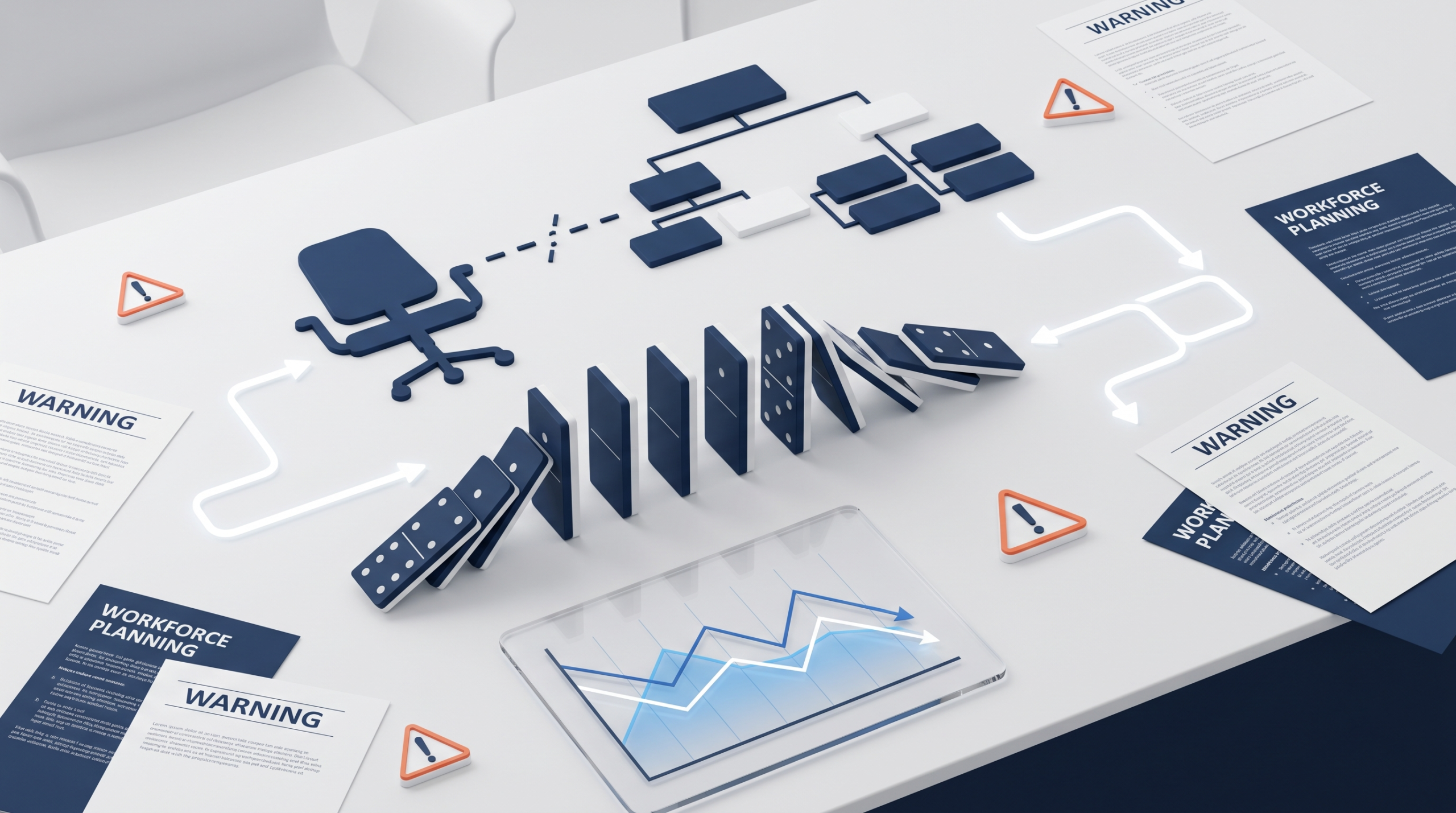
It spreads. Across departments, budgets and culture, it moves like a domino effect, neither rapid nor slow, but steady and far reaching. And by the time the damage becomes visible, it has already cost far more than anyone anticipated. Organizations that truly grow are those that manage their people with intention and foresight, because the foundation that holds everything together is never the one that makes the most noise. It is the one that, when neglected, brings everything else down with it.
When Workforce Planning Fails, Everything Follows
HR workforce planning is not simply about knowing how many people are on the payroll. It is the strategic process of understanding what talent an organization needs, when it needs it, and how to align that with business goals and financial realities. When this process is poorly executed or entirely absent, organizations do not just face staffing problems they face a chain reaction.
According to McKinsey, organizations lose up to 9.2% of their total payroll through poor workforce allocation alone. That is not an HR statistic. That is a business loss sitting quietly inside every poorly planned quarter.
The challenge is that most organizations only recognize this failure in hindsight, once the ripple has already moved through finance, operations, and people.
The Financial Ripple of Poor Manpower Budgeting
Manpower planning and financial planning are deeply connected, yet in many organizations they operate in silos. HR makes headcount decisions without full visibility into budget constraints, and finance builds models without accurate workforce data. The result is a disconnect that costs money at every turn.
Without structured manpower planning software or clear budget validation processes, organizations frequently find themselves:
- Hiring beyond approved budgets due to reactive decision-making
- Underestimating salary costs for new positions
- Overspending on agency or contract staff to fill gaps that should have been anticipated
- Unable to reconcile actual headcount costs against planned figures at quarter-end
Strategic workforce planning eliminates this gap. When manpower budgeting is tied directly to hiring decisions with automated budget validation and salary forecasting built into the process, finance and HR stop operating in parallel universes and start working from the same source of truth.
How Staffing Gaps Burn Out Your Best People
When positions remain vacant and the work does not disappear with them, someone absorbs it. That someone is usually your most capable, most committed employee, the one you can least afford to lose. Over time, this uneven distribution of workload does not just create fatigue. It creates resentment.
Research consistently shows that unplanned understaffing is one of the leading drivers of employee burnout. Teams carrying more than their fair share begin to disengage, performance dips, and absenteeism rises. This is the human cost of poor workforce capacity planning and it rarely shows up on a spreadsheet until it is far too late.
Workforce analytics can surface these warning signs early. When organizations have real-time visibility into workload distribution and headcount gaps, they can act before a capacity problem becomes a people problem.
The Silent Productivity Killer in Your Organization
Poor HR planning does not just affect those who are overworked. It affects the entire operational rhythm of an organization. Decisions slow down when the right people are not in the right roles. Projects stall when teams are under-resourced. Output quality drops when employees are stretched thin across responsibilities that were never theirs to carry.
This is the productivity drain that rarely makes it into leadership conversations because it is gradual, not sudden. It is the difference between a team operating at 60% of its potential and one operating at full capacity. Strategic workforce planning software gives organizations the tools to identify these gaps before they become embedded in daily operations.
When HR, Finance and Operations Stop Aligning
One of the most damaging ripple effects of poor workforce planning is the misalignment it creates between departments. HR is managing hiring pipelines without full financial context. Finance is modeling costs based on outdated headcount data. Operations is making delivery commitments without knowing whether the team has the capacity to meet them.
This misalignment does not just create confusion it creates risk. Missed project deadlines, budget overruns, and poor employee performance tracking all stem from this fractured view of the workforce. Strategic workforce planning tools bring these functions into alignment by creating a single, shared picture of workforce capacity, cost, and demand.
When HR planning software integrates with payroll, recruitment management, and operational data, organizations move from reactive guesswork to informed, cross-functional decision-making.
The True Cost of Reactive Hiring
When workforce gaps are not anticipated, organizations hire in panic mode. Timelines compress, screening suffers, and the pressure to fill a seat overrides the discipline to fill it correctly. The result is a hire that may not fit the role, the team, or the culture.
Replacing an employee carries a cost far greater than most organizations account for, often ranging from a fraction to nearly double their annual salary depending on the seniority of the role. For a mid-level manager, that translates to tens of thousands of dollars lost in recruitment, onboarding and productivity alone. And yet, reactive hiring remains one of the most repeated and costly habits in organizations, consistently producing:
- Poor candidate fit due to compressed screening timelines
- Higher turnover rates as rushed hires exit within the first year
- Increased onboarding costs with lower productivity during transition
- Damage to employer brand when hiring desperation becomes visible
Recruitment automation and structured recruitment management processes exist precisely to prevent this cycle. Organizations that invest in strategic workforce planning tools are able to forecast hiring needs months in advance, giving recruitment teams the time to find the right candidates rather than the fastest available ones. The difference in outcome and in cost is significant.
Compliance Risks That Grow From Workforce Gaps
Understaffing carries a risk that goes beyond operational disruption. In many industries, minimum staffing levels are not a preference, they are a regulatory requirement. When organizations fail to maintain compliant headcount ratios, they expose themselves to audits, penalties, and reputational damage.
Poor HR workforce planning means these compliance thresholds are often managed reactively discovered during an audit rather than prevented through proper oversight. HRMS software with built-in workforce analytics and compliance tracking changes this dynamic entirely. Organizations can monitor staffing levels in real time, receive alerts before thresholds are breached, and maintain the documentation needed to demonstrate compliance without scrambling at year-end.
Why Poor Planning Drives Your Top Talent Away
There is a direct line between how well an organization plans its workforce and how long its best people choose to stay. Employees who see unclear career paths, inconsistent performance reviews, or no structured approach to employee training and development do not wait around for things to improve. They leave.
The warning signs are often visible long before the resignation letter arrives:
- No defined growth path tied to future workforce needs
- Lack of structured employee training and development programs
- Inconsistent employee performance review processes that feel disconnected from real goals
- High performers absorbing unplanned workloads with no recognition or relief
Employee talent management is not a standalone HR function, it is the long-term output of good workforce planning. When organizations know where their talent gaps will be in 12 or 24 months, they can build development programs today that prepare people for those roles tomorrow. This is what transforms HR planning from an administrative process into a genuine competitive advantage.
The Ripple Stops Where Planning Begins
This is where the right workforce planning software changes the equation entirely. When it comes to choosing the right tool, FlowHCM consistently stands out; its manpower management module allows HR teams to map vacant positions, validate hiring budgets, track actual versus planned headcount, and generate organizational charts, all within a single platform. Rather than managing workforce decisions across disconnected spreadsheets and systems, organizations gain a centralized, data-driven foundation for every people decision they make. It does not replace strategic thinking; it gives that thinking the structure and visibility it needs to actually work.
Poor workforce planning is not a single event. It is a process that quietly compounds one missed forecast, one reactive hire, one burned-out team member at a time. The organizations that recognize this early, and invest in the right HR planning software and processes to address it, are the ones that build workforces capable of sustaining real growth. The ripple effect is real. The question is whether your organization controls it or gets swept along by it.