




Every organization sits on a wealth of employee data, including attendance records, performance scores, hiring metrics, turnover patterns, and engagement survey results. This information flows through HR systems daily, yet most companies fail to extract meaningful value from it. The uncomfortable reality is that many organizations make critical decisions about their workforce based on intuition rather than evidence. They react to problems after they surface instead of anticipating them, and they struggle to understand why competitors consistently attract better talent and achieve higher retention rates.
The difference between high-performing organizations and the rest often comes down to one capability: data-driven decision-making. HR analytics bridges the gap between raw information and strategic action, transforming scattered data points into clear insights that help leaders hire more effectively, retain their best people longer, and plan for the future with confidence.
Explaining the four core types of HR analytics, examines why organizations need them in today’s competitive landscape, and demonstrates how the right technology turns analytics from a concept into a practical, everyday tool for better workforce management.
A Deep Dive into the 4 Core HR Analytics
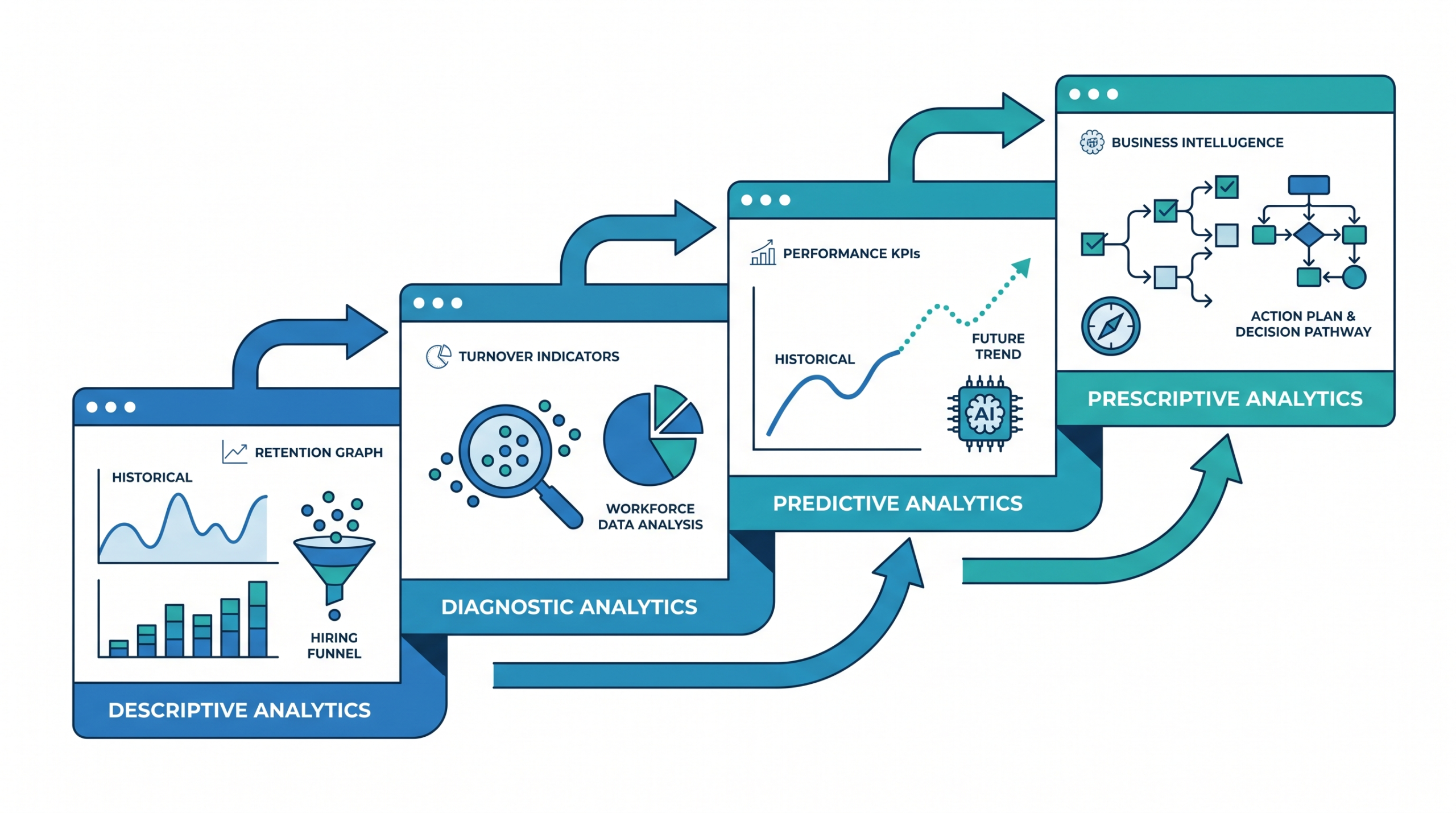
The “Core HR Analytics” refers to four distinct methods of analyzing HR data. Think of them as a staircase. Each step builds on the one before it, taking you from knowing what happened to knowing exactly what to do about it.
-
Descriptive Analytics: What Happened?
Descriptive analytics summarizes historical data to help you understand past performance and current situations. You cannot fix what you do not measure. This method gives you the baseline, the raw facts about your workforce today compared to yesterday.
What it looks like in HR:
- Tracking your monthly turnover rate
- Reviewing how many days it took to fill open positions
- Looking at employee demographic breakdowns
- Calculating absenteeism percentages
-
Diagnostic Analytics: Why Did It Happen?
Diagnostic analytics digs deeper to find the root causes of trends identified by descriptive analytics. A high turnover number tells you something is wrong, but diagnostic analytics tells you exactly what that something is. Without this step, you might throw solutions at the wrong problems.
Common applications across HR functions:
- Analyzing exit interview data to understand why people leave
- Comparing your salaries against market rates
- Examining engagement survey results by department
- Investigating why certain teams have higher absenteeism
-
Predictive Analytics: What Might Happen?
Predictive analytics uses historical data, statistical modeling, and AI to forecast future workforce trends. Would you rather prevent turnover than react to it? This method helps you spot problems before they happen, giving you time to act. Strategic impact happens at the predictive level.
Typical scenarios in HR operations:
- Identifying which employees are at high risk of leaving
- Forecasting which departments will need more staff in the next quarter
- Predicting which candidates are most likely to succeed
- Anticipating skill gaps before they become problems
-
Prescriptive Analytics: How Can We Make It Happen?
Prescriptive analytics recommends specific actions to take based on insights from predictive analytics. Knowing a problem is coming is useful, but knowing how to stop it is invaluable. This method gives you a clear action plan.
What this means for your HR team:
- Recommending personalized training paths for each employee
- Suggesting the best retention strategy for an at-risk team member
- Optimizing shift schedules based on predicted demand
- Determining which compensation adjustments will most reduce turnover risk
Why Organizations Need HR Analytics in Today’s World
The world of work has changed, and those who fail to adapt are falling behind. Here is why HR analytics has moved from a nice-to-have to a business necessity:
Strategic Workforce Management
HR has evolved beyond administrative functions to become a key driver of business success. HR analytics enables organizations to make workforce decisions that directly support growth, productivity, and performance.
Making Sense of Workforce Data
Employee data is generated across recruitment, attendance, performance, training, and payroll systems. HR analytics converts this data into actionable insights that support informed decision-making.
Stronger Talent Management
Analytics helps organizations attract, retain, and develop top talent more effectively. It provides visibility into hiring success, employee performance, turnover risks, and learning outcomes.
Reducing Costly HR Mistakes
Decisions based on assumptions can lead to poor hiring, higher turnover, and wasted training investments. HR analytics replaces guesswork with evidence-based strategies that improve results.
Proactive Decision-Making
Rather than reacting to workforce challenges after they occur, HR analytics helps identify trends and risks early. This allows organizations to take preventive action and plan for future workforce needs.
In today’s dynamic workplace, HR analytics transforms workforce data into actionable insights that improve hiring, retention, productivity, and decision-making. By enabling proactive workforce strategies, it helps organizations build a more engaged, efficient, and high-performing workforce.
The Real Challenges Standing in the Way
While HR analytics offers significant benefits, many organizations face obstacles when adopting and scaling data-driven HR practices. Understanding these challenges is the first step toward building a successful analytics strategy.
1. Data Silos and Fragmented Systems
When workforce data is scattered across multiple platforms, generating meaningful insights becomes a challenge.
- Employee data is often spread across payroll, recruitment, attendance, and performance systems.
- Disconnected platforms make it difficult to create a unified view of the workforce.
- HR teams spend valuable time gathering data instead of analyzing it.
2. Skills Gap in HR Teams
The effectiveness of HR analytics depends not only on technology but also on the ability to interpret and act on data.
- Many HR professionals have limited experience with data analysis and interpretation.
- Advanced analytics tools provide little value without the skills to use them effectively.
- Organizations must invest in data literacy and continuous upskilling.
3. Data Quality and Trust Issues
Reliable analytics starts with reliable data. Poor-quality information can undermine decision-making and confidence in results.
- Inaccurate or incomplete data can lead to unreliable insights and poor decisions.
- Consistent data management practices are essential for meaningful analytics.
- Strong privacy, security, and governance measures help build employee trust.
4. Resistance to Data-Driven Decision Making
Shifting from traditional decision-making methods to data-backed strategies often requires a cultural change.
- Some leaders continue to rely on experience and intuition rather than data.
- Analytics may challenge existing assumptions, creating resistance to change.
- Demonstrating measurable results helps encourage wider adoption.
5. Lack of Executive Buy-In and Resources
Without leadership support, even the most promising HR analytics initiatives can struggle to gain momentum.
- Successful HR analytics initiatives require investment in technology and talent.
- Limited budgets and resources can slow implementation efforts.
- Leadership support is crucial for driving long-term analytics success.
How Smart HR System Bridges the Gap
FlowHCM embeds analytics into everyday HR processes, turning fragmented workforce data into actionable intelligence rather than an afterthought.
Centralized Data (No Silos): Unifies all HR information into one secure system, enabling complete visibility across recruitment, performance, engagement, and training without manual data handling.
Automated Reporting: Schedules and delivers reports automatically, reducing manual effort while ensuring consistent, timely workforce insights for decision-makers.
Custom Dashboards: Provides role-based, customizable dashboards so executives, managers, and HR teams can access relevant, actionable insights in real time.
Advanced Analytics: Delivers deep insights into workforce trends, performance, retention risks, and skill gaps, supported by accurate, real-time data.
Workforce Planning: Enables proactive staffing decisions through budget control, headcount analysis, succession planning, and organizational visibility.
Real-Time Insights: Ensures decisions are based on current data, helping organizations respond faster and act on opportunities or risks immediately.
Conclusion
HR is no longer just an administrative function, but it is a strategic driver of business performance. The shift to analytics transforms HR from reactive reporting to proactive decision-making, enabling smarter hiring, stronger retention, and better workforce planning.
Platforms like FlowHCM make this transformation practical by centralizing data, automating insights, and enabling real-time, data-driven decisions. In today’s competitive environment, organizations that leverage HR analytics don’t just manage their workforce; they optimize it for long-term success.