





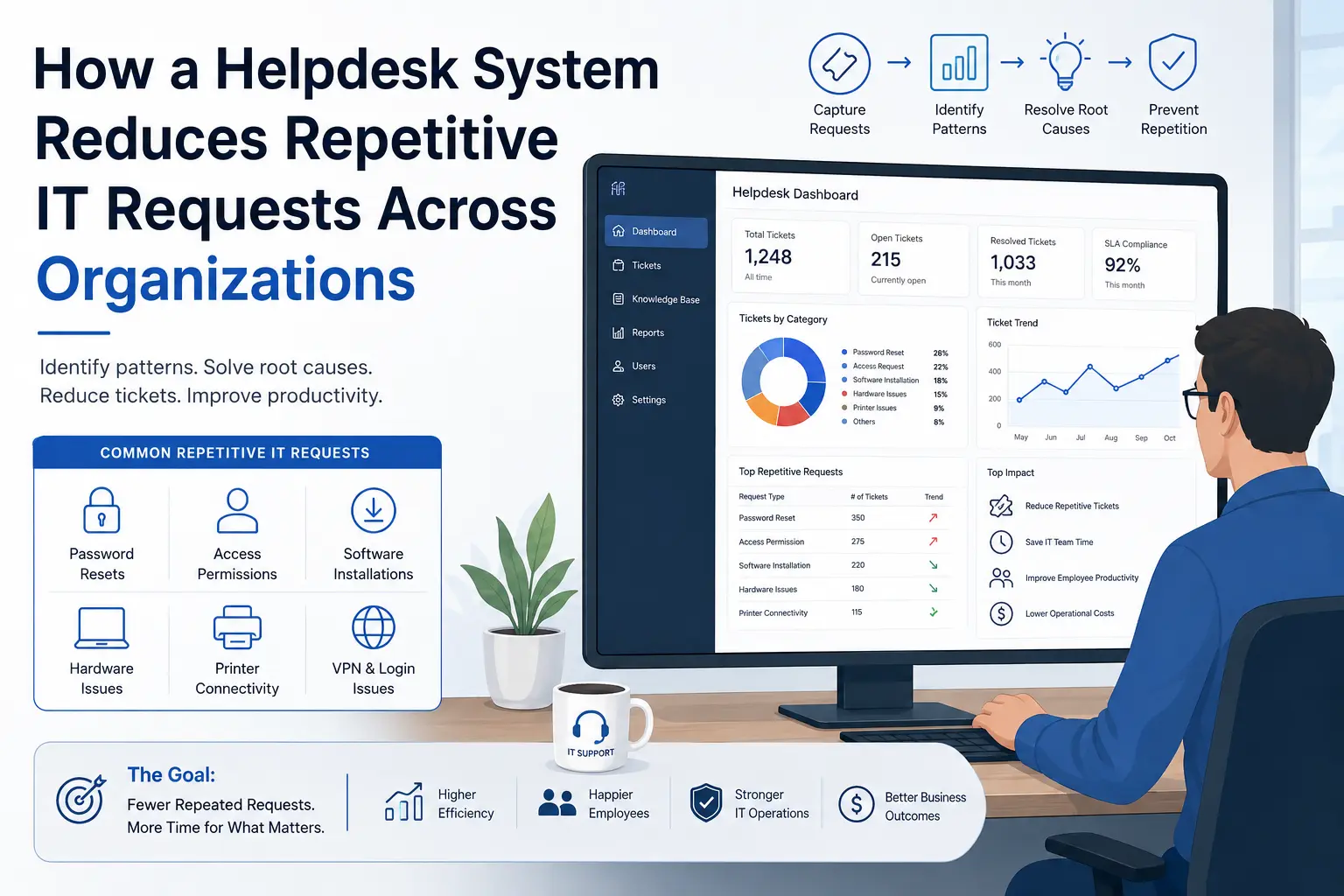
Somewhere in every organization, a familiar request is being typed out right now. A forgotten password. A printer that refuses to connect. A new joiner waiting on software access. These moments feel small on their own, but they repeat so often that they quietly take up a large part of how IT support spends its day.
Repetitive IT requests are rarely random. They are signals that point toward gaps in process, documentation, or visibility within an organization. When the same issues keep surfacing, it usually means something behind the scenes still needs attention rather than the request itself being the actual problem.
A helpdesk system does more than collect and organizes these tickets. It helps organizations recognize the patterns behind the noise and reduce recurring requests over time, turning everyday support work into a source of long-term improvement rather than a constant cycle of repetition.
Why Repetitive IT Requests Become a Growing Business Challenge
As organizations grow, the volume of recurring requests tends to grow even faster. New hires need accounts set up, system access granted, and devices configured, and each onboarding cycle reintroduces the same set of questions and issues. Frequent changes to internal systems, tools, or vendors add another layer, since employees often need repeated guidance just to adjust to what changed.
The result is that IT teams spend a disproportionate share of their time resolving familiar, low-complexity issues. This steadily reduces their capacity for higher-value work such as system upgrades, security improvements, or infrastructure planning. What looks like routine support on any single day becomes, over time, a structural drain on an organization’s technical capacity.
The Hidden Cost of Solving the Same Problems Every Day
The impact of repetitive requests extends well beyond IT workload. When the same issues resurface again and again, the costs spread across the wider business in ways that are easy to underestimate.
- Lost productivity, as employees wait for resolutions to issues that have already been solved many times before
- Delayed strategic projects, since support teams remain occupied with recurring fixes instead of forward-looking initiatives
- Employee downtime, particularly when access or hardware issues block daily tasks
- Increased operational costs tied to repeated troubleshooting rather than permanent resolution
- Support team burnout, as handling the same requests repeatedly can feel unproductive and demotivating over time
None of these costs show up clearly on a single ticket. They accumulate, and that is precisely what makes them easy to overlook until they affect overall performance.
Why Manual Support Makes Recurring Issues Hard to Identify
One reason recurring request persist is that many organizations lack the structure to notice them in the first place. Support conversations scattered across email threads tend to disappear into inboxes, with no easy way to trace how often a particular issue has come up. Chat-based requests are rarely searchable in any meaningful way, which means valuable context is lost almost as soon as a conversation ends.
Without a centralized history, there is no single place to look back and identify trends. Different employees also tend to describe the same underlying issue in different words, which makes it harder to connect related tickets even when they stem from the same root cause. As a result, organizations often end up addressing symptoms one at a time instead of identifying and fixing what is actually causing the repetition.
How a Helpdesk System Turns Individual Tickets Into Actionable Trends
A helpdesk system changes this by giving every request a consistent structure, which makes patterns visible instead of hidden. Once requests are logged in one place, IT teams can begin to see the bigger picture rather than reacting to isolated incidents.
- Categorizing requests by type, making it easier to spot which issues occur most frequently
- Identifying recurring issue types across teams, locations, or departments
- Tracking request frequency over weeks or months to understand whether a problem is growing or shrinking
- Recognizing seasonal or department-specific patterns, such as spikes during onboarding periods or system rollouts
- Using historical data to understand recurring problems instead of relying on memory or assumption
This shift, from individual tickets to collective insight, is what allows organizations to move from simply closing requests to genuinely understanding them.
From Reactive Support to Preventive Problem Solving
Once patterns become visible, organizations are in a position to address root causes rather than repeatedly treating symptoms. This often involves improving internal processes that were contributing to confusion in the first place, or updating policies that no longer reflect how teams actually work.
Recurring technical issues, once identified clearly, can be fixed at the source instead of being patched temporarily each time they resurface. The broader goal is prevention: stopping a request from happening again rather than simply resolving it faster the next time it appears. This is the difference between a support function that reacts to problems and one that actively reduces them.
Common Types of Repetitive IT Requests That Organizations Can Reduce
Certain categories of requests tend to repeat across almost every organization, regardless of size or industry. These typically include:
- Password resets
- Access permission requests
- Software installation requests
- Hardware issues
- Printer connectivity problems
- VPN and login issues
The value here is not in solving each of these individually, but in recognizing them as categories. Once an organization understands which types of requests recur most often, it becomes possible to address the underlying causes systematically rather than handling each occurrence as a fresh, unrelated issue.
Building a More Efficient IT Support Process Through Continuous Improvement
Reducing repetitive requests is not a one-time fix; it is an ongoing discipline. Organizations that succeed at this tend to follow a consistent set of practices.
- Reviewing ticket trends regularly to catch emerging patterns early
- Prioritizing recurring issues over isolated, one-off requests
- Improving documentation so common problems are easier to resolve and easier to prevent
- Standardizing common processes to reduce inconsistency across teams
- Measuring whether recurring requests actually decrease over time, rather than assuming improvement has occurred
This continuous loop of reviewing, adjusting, and measuring is what separates organizations that gradually reduce their support burden from those that remain stuck managing the same issues year after year.
Reducing Tickets Starts With Understanding Them
Repetitive IT requests are rarely the real problem; they are symptoms of larger gaps in process, documentation, or system design. Treating them only as tickets to close means missing the opportunity to address what is actually causing them. A helpdesk system helps organizations shift away from repeatedly solving the same issues and toward continuously improving how internal support works, one pattern at a time.
This is where a centralized helpdesk management system, such as the Help Desk module within FlowHCM, becomes useful. By bringing requests, tracking, and resolution history into a single structured view, it gives organizations the visibility needed to understand recurring issues rather than just respond to them. Viewed this way, a helpdesk solution is not simply a tool for managing IT requests; it is a foundation for long-term operational efficiency across the wider organization.