





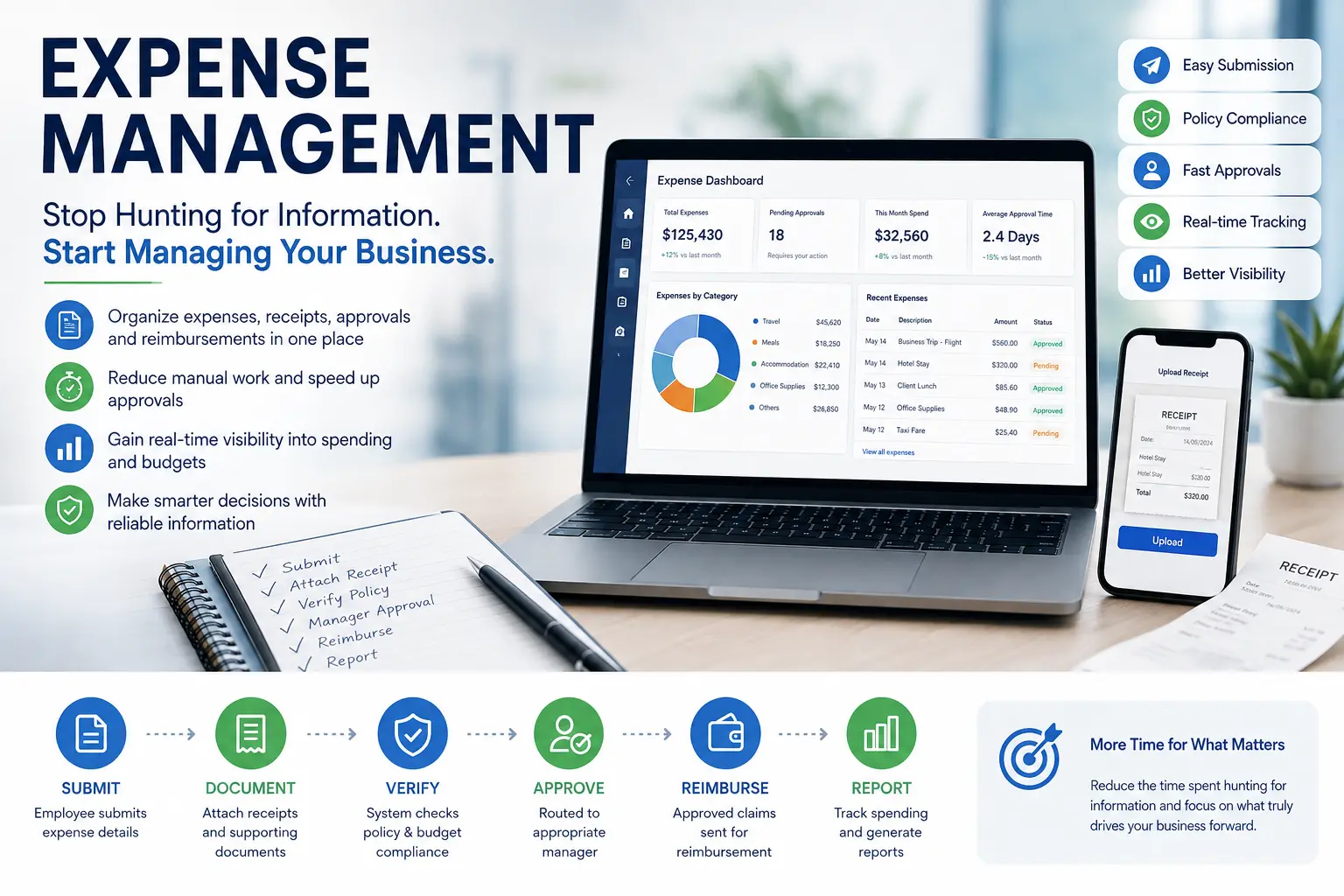
Expense Management helps businesses organize employee expenses, receipts, approvals, reimbursements, and spending data in one clear process. Expense Management Software reduces manual work by streamlining approvals, enforcing policies, and improving spending visibility. A strong process helps employees submit complete claims and gives managers clearer control. Ultimately, reliable information allows finance teams to spend less time chasing paperwork and more time managing budgets and supporting business decisions.
How much of your finance team’s time is spent processing expenses, and how much is spent hunting for the information needed to process them? Expense processing looks simple on paper. An employee submits a claim, a manager approves it, and finance issues the reimbursement. Behind that ideal scenario lies a daily reality of lost receipts, unconfirmed budgets, and endless status updates. Finance teams constantly chase missing details, remind busy managers, verify policy compliance, and search cluttered email threads. What should be a quick task turns into a time-consuming search for context.
The root issue for most companies isn’t slow processing. The real problem is scattered information across inboxes, paper receipts, spreadsheets, and multi-tier approval chains. Fragmented data leads to heavy administrative workloads, delayed employee payments, higher risk of human error, and poor visibility into spending patterns. Modern Expense Management brings structure to these disconnected pieces. A centralized expense management system makes information easy to find, verify, and act on across the organization.
Expense Management Should Reduce Information Hunting
Smart expense management gives finance teams a clear process for finding, checking, approving, and tracking expense information. Processing an expense means taking a complete record, checking it against company guidelines, and issuing payment. Finding everything needed to process that expense is where the hidden labor occurs.
Finance professionals must handle submission details, gather supporting documentation, verify policy terms, run budget checks, secure management sign-offs, execute reimbursements, and log entries for reporting. A five-minute expense submission can generate an hour of extra work if initial information is incomplete or disconnected from the primary claim record.
Manual expense processes create hidden work because finance teams must repeatedly collect, verify, correct, and chase information.
The Information Finance Teams Keep Hunting For
Small information gaps routinely produce substantial operational bottlenecks. Finance teams spend hours every week searching for basic data points:
- Missing paper or digital receipts
- Incorrect expense categories
- Incomplete claim details
- Applicable policy requirements
- Current department budget availability
- Overdue manager approvals
- Current reimbursement status updates
- Historical expense records
A single unattached receipt forces finance to email the employee, wait for a response, re-review the record, and resend the approval request. This unnecessary communication chain results from constant coordination rather than the expense itself.
Delayed Expense Approval Creates Business-Wide Friction
Delayed expense approval affects employees, managers, finance teams, and leadership by slowing reimbursements and reducing spending visibility.
- Employees feel the delay first: delayed repayments cause personal financial uncertainty and prompt constant status inquiries. Managers become the bottleneck as unconsolidated approval requests get lost in busy daily work streams.
- Finance carries the administrative cost: Accounting absorbs the overhead of manual follow-ups, corrections, and line-by-line tracking.
- Leadership loses spending visibility: Outdated data prevents executives from tracking current cash outflow or monitoring budgets accurately.
Employee Expense Management Starts With Better Information
Employee Expense Management works better when employees can submit complete, accurate claims without unnecessary steps.
- Clear submission requirements: Staff know explicit guidelines and required fields before submitting.
- Simple expense categories: Pre-defined categories eliminate guessing games and downstream corrections.
- Easy receipt submission: Supporting evidence attaches directly to the line item at entry.
- Clear status visibility: Self-service tracking allows employees to view claim progress independently.
- Fewer correction cycles: Complete initial submissions eliminate back-and-forth loops.
Better Receipt Management Keeps Evidence With Every Expense
Good receipt management keeps supporting documents connected to the relevant expense, making verification faster and reducing missing information.
The Problem With Scattered Receipts
When receipts live separately from expense logs, stored across email attachments, paper piles, phones, or chat apps, finance teams hold the claim but lack the proof to validate it. The real goal is to bind the correct documentation directly to its matching claim.
Expense Management Software Turns Scattered Information Into a Clear Workflow.
Expense Management Software can centralize expense information and reduce manual coordination when reviewing and processing claims. Finance teams spend less time chasing approvals because claims move systematically through a defined digital pipeline.
Implementing structured expense management solutions consolidates data entry points. Digital documentation stays tied directly to expense lines. Structured submissions prevent missing fields. Automated routing lands on the manager’s desk, and built-in policy checks flag anomalies instantly.
What Good Expense Management Software Should Simplify
- Collecting structured claim details from mobile or web interfaces
- Attaching digital receipts to each claim, with the option to apply multiple expenses in a single request.
- Verifying required policy fields before submission
- Routing claims along predefined approval chains
- Providing clear claim status tracking for employees
- Organizing expenditure data into clean dashboards
An Expense Management System Should Connect Every Step
An Expense Management System should connect submission, documentation, verification, approval, reimbursement, and reporting in one clear workflow.
- Submit: The employee records outlay details through standardized input screens.
- Document: Receipts, including receipts from travel management, are linked directly to the claim.
- Verify: Automatic checks confirm the claim complies with active spending limits.
- Approve: The system routes the verified file directly to the appropriate supervisor.
- Reimburse: Approved claims stream straight to payroll or direct payment queues.
- Report: Finance reviews organized cost metrics and tracks departmental trends.
Expense Tracking Software Gives Leaders Better Spending Visibility
Expense Tracking Software helps businesses see where money is going without relying on manually compiled spreadsheets.
Centralized data gives corporate leadership a firm basis for strategic planning. Executives can identify spending trends, spot redundant operating costs, monitor division budgets in real time, and investigate unusual account activity early.
Better Expense Management Makes Policy Control Easier
Better expense management makes policies easier to apply because requirements become part of the workflow rather than relying on manual checks.
Catching errors at the entry point is better than discovering discrepancies weeks later during month-end reconciliation or financial audits. An incomplete expense caught during initial creation takes seconds to fix. Finding it a month later requires multi-departmental research and tedious adjustments.
A Strong Expense Workflow Gives Finance Time Back
A strong expense workflow reduces repetitive administrative work so that finance teams can spend more time on analysis, control, and planning.
| Manual Workflow | Structured Workflow |
| Find missing documentation | Submit through guided interfaces |
| Manually check policy compliance | Automatically verify against policy |
| Chase managers for signatures | Route to approving managers |
| Correct inaccurate account codes | Reimburse via direct integrations |
| Re-check revised claims | Report across standardized dashboards |
Modern software is not meant to replace human judgment. An efficient process eliminates the constant searching, emailing, and paperwork administration surrounding critical financial decisions.
A Strong Expense Process Should Pass This Finance Checklist
A strong expense process should make every claim easy to submit, verify, approve, track, and report.
- Can employees submit complete expense claims from any location?
- Are digital receipts attached directly to each claim line?
- Can managers see and action pending approvals in one place?
- Are corporate spending limits enforced automatically during entry?
- Do employees have direct visibility into reimbursement progress?
- Can reports be created without assembling manual spreadsheets?
Give Your Finance Team More Time to Manage Money, Not Missing Information
Better expense management reduces the time finance teams spend hunting for receipts, approvals, policy details, and spending information. Finance professionals were never meant to operate as private detectives chasing missing paperwork across different departments.
Transitioning to a structured workflow gives staff an effortless way to lodge costs, gives managers a clean path to approve outlays, and gives accounting teams complete records to maintain financial control.
The primary goal is to make every operational expense clear to view, simple to confirm, quick to approve, and easy to report. When finance teams spend less time hunting down information, they have more time to use it to grow the business.