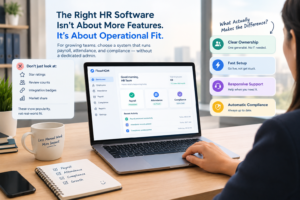





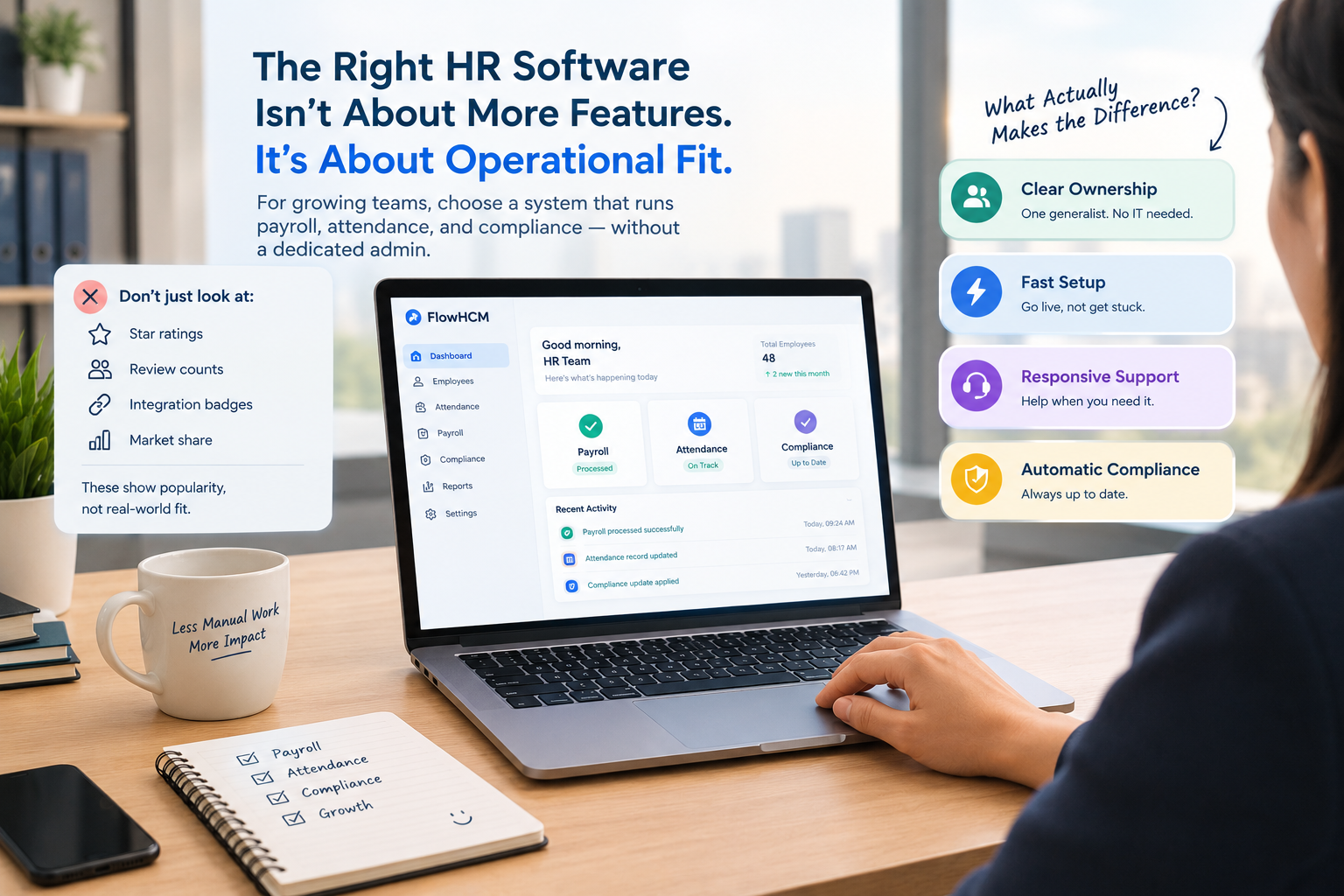
HR software for growing teams should be judged on operational fit, not review counts or feature lists. The right fit for a lean HR team running payroll, attendance, and compliance without a dedicated admin comes down to four factors: clear ownership, fast setup, responsive support, and automatic compliance updates. Tools that top generic rankings often assume IT backup that small teams don’t have, which shows up as hidden setup time and manual work after go-live.
One ranking, and no answer for the person who actually has to run the winner.
Star ratings, review counts, and integration badges: that’s how most HR platforms get ranked. None of those numbers say whether a two-person team can actually run the winner without hiring someone just to manage it. That gap is the blind spot in almost every ‘best HR software’ list published today.
Growing teams don’t need the most decorated tool. They need one that won’t turn into a part-time project the moment payroll, attendance, and compliance land on one desk. That’s the lens generic rankings skip, and it’s what actually decides whether new HR management software frees up your week or fills it.
The Hidden Math Behind Every ‘Best HR Software’ Ranking
Most software rankings are built from three inputs: review volume, integration count, and market share. None of those measure how much work a tool takes to run once you’ve bought it.
A platform with a thousand reviews and fifty integrations can still take weeks to configure without a dedicated admin. Listicles rarely mention setup time, support response, or how much manual work survives after go-live. They score visibility, not day-to-day fit, for a five-person team evaluating new HR software.
Capacity, Not Features, Is What Breaks Lean HR Teams
For growing teams, the constraint isn’t functionality. It’s capacity. Payroll accuracy, attendance tracking, and compliance updates all land on one generalist, not a dedicated systems team. An HR management system built with enterprise IT support in mind will quietly push that workload back onto whoever owns HR.
The signs show up fast:
- Approval chains that need manual follow-up instead of running on their own
- Attendance and payroll living in separate logins that require daily reconciling
- Compliance updates that need a support ticket instead of applying automatically
- Onboarding that takes days of manual data entry per new hire
When the Top-Ranked HR Software Becomes Your Biggest Time Sink
The tools that top the lists often win on brand recognition, not ease of operation. Many were built for enterprise HR departments with dedicated administrators, then marketed down to smaller teams without adjusting the setup complexity.
That mismatch surfaces in the first few months. Rollout stretches past the promised timeline. Support tickets pile up. The HR management software that looked simplest in a demo ends up needing a part-time administrator just to keep it running.
Employee Attendance Management Breaks First in Growing Teams
HR Management System problems usually surface here first. Manual timesheets and shift spreadsheets work fine for ten people. They stop working at thirty, once overlapping shifts and remote check-ins turn Employee Attendance Management into a daily reconciliation job instead of a background process.
The break rarely shows up in a listicle. It shows up in overtime disputes, late payroll corrections, and managers approving hours from memory instead of a record. A system that logs attendance in real time removes that entire category of error, without adding a step for the employee or the manager.
Employee Payroll Management Can’t Run on One Person’s Memory
Employee Payroll Management tends to fail quietly long before it fails visibly. A missed deduction, a late attendance sync, or a manual tax update can throw off a full pay cycle, and the person catching the error is usually the same person who caused it.
For a lean team, the risk grows with every new location or shift type. Common failure points include:
- Salary adjustments made outside the system of record
- Tax and compliance updates applied late or inconsistently
- Attendance data pulled in through manual re-entry instead of syncing automatically
This is where HR Management Software earns its cost back. Tying attendance directly to payroll calculation means payroll doesn’t wait on a manual handoff every cycle, and a single HR Management System running both removes the reconciliation work entirely.
The Buying Framework for HR Software That Runs Itself
Choosing HR software for a lean team means weighing a different set of signals than a listicle does. Four questions matter more than feature count:
- Ownership clarity: Can one generalist run this without pulling in IT?
- Setup timeline: How long until payroll and attendance are fully live, not just installed?
- Support responsiveness: Does help arrive in hours, or does it sit in a queue?
- Compliance updates: Do they apply automatically, or require a support request each time?
This is the framework FlowHCM was built around. It handles payroll, attendance, and compliance updates without requiring a dedicated administrator, which is exactly what most rankings overlook.
HR Software That Works for You, Not the Other Way Around
A ranking can tell you how many people liked a tool. It can’t tell you how much work that tool will hand back to you once it’s live. Growing teams need to measure something else: how much work a tool creates after the contract is signed. The right HR management system doesn’t make you an IT department. It runs payroll, tracks attendance, and updates compliance on its own, so HR software stays a tool you use, not a project you manage.