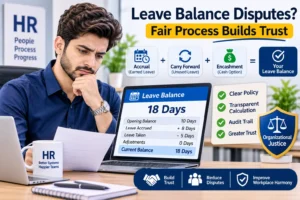


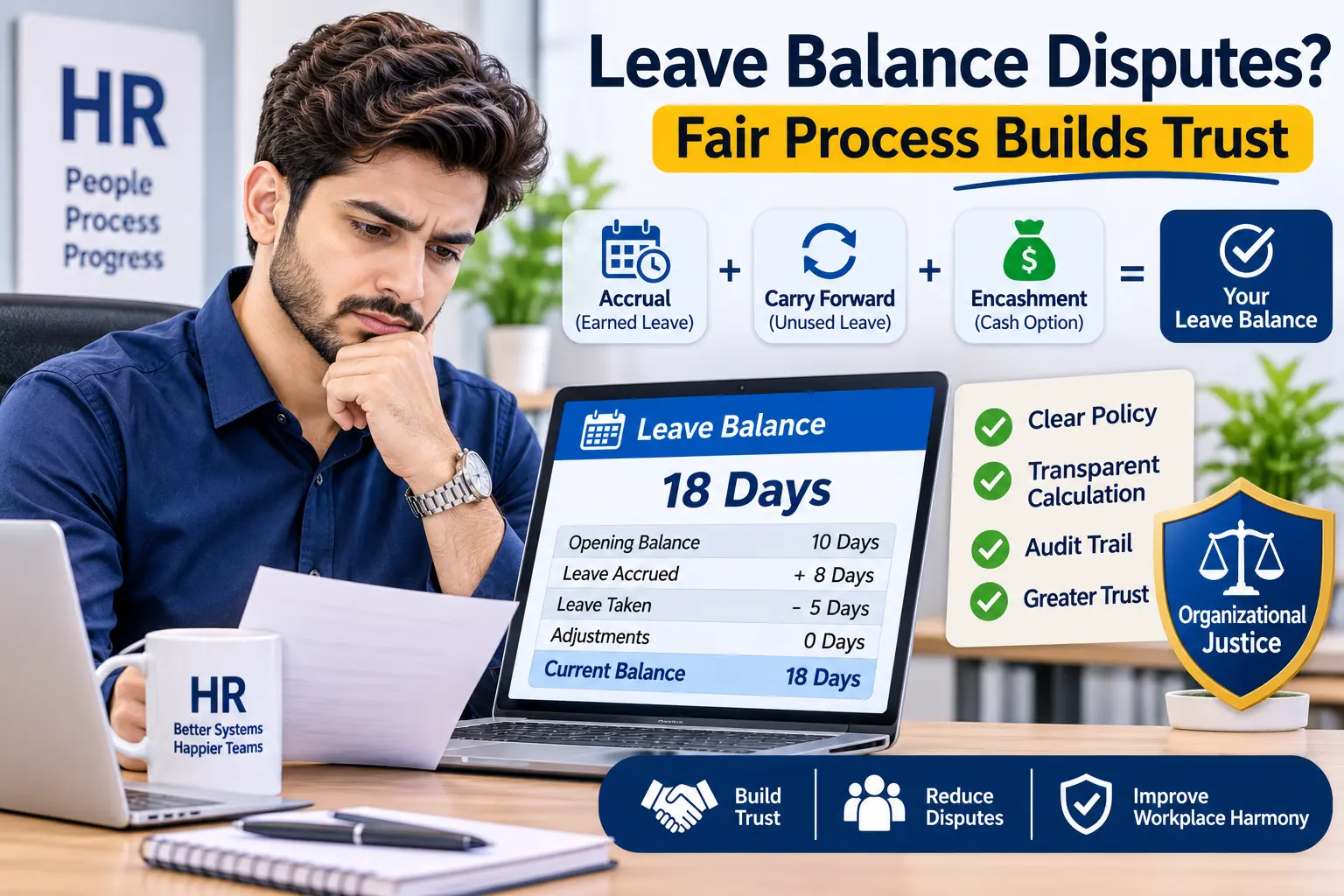
A leave balance is the number of leave days an employee has left after accrual, approved leave, and adjustments. Disputes start when employees cannot see how that number was reached. Organizational justice explains why: people judge both the outcome and the process behind it. A published policy, a visible calculation, and an audit trail turn contested balances into settled ones.
An employee who challenges a leave balance is seldom arguing over one missing day. They are asking whether the company counts fairly. HR hears a math problem. The employee hears silence where an explanation should be. That silence costs trust.
Organizational justice research explains the gap. People judge fairness twice. First they judge the outcome they received. Then they judge the process that produced it. In Pakistan, many teams still reconcile leave in spreadsheets and chat threads, so the second judgment often decides the dispute. Each dispute then eats hours of HR time. This article shows HR leaders where trust breaks, what fair practice looks like, and how a leave management system keeps the record honest. Fix the process, and most disputes close before they open.
Two Kinds of Fairness Employees Judge at Once
Employees weigh the final number and the way you reached it, and they punish a weak process harder than a small shortfall.
Distributive justice asks, “Did I get what I deserve?” Procedural justice asks, “Was the method consistent, transparent, and open to appeal?” A worker who loses two days under a clear rule usually accepts it. A worker who loses nothing under a hidden formula keeps asking questions. In a disputed leave balance, procedure is usually the real complaint.
Accrual, Carry Forward and Encashment Defined
These three rules set every balance an employee sees. The table defines each one in plain terms.
| Term | Definition | Question it answers |
| Accrual | Leave earned gradually, such as 1.5 days a month, instead of granted upfront. | How did I earn this? |
| Carry forward | Unused leave moved into the next year, usually up to a set cap | What happens to days I skip? |
| Encashment | Cash paid for unused leave, often at exit or year-end | Can I get paid for them? |
Each term hides a policy choice. Your leave accrual method, leave carry-forward policy, and leave encashment terms must be written down and shown to staff. Pakistani employers often set these in the employment contract or handbook, so employees expect to read them there.
Where Trust in a Leave Balance Breaks Down
Trust breaks when employees cannot see how a balance changed, or who changed it. Manual leave tracking errors are usually small, but staff read them as unfairness. Watch for these triggers:
- A leave carry forward policy announced by email but missing from the handbook
- Public holiday and weekend rules applied differently by different managers
- Unpaid leave deduction posted after payroll closes
- Sick leave and casual leave booked against the wrong bucket
- Spreadsheet edits with no record of who made them
A Fair Process Employees Can Check for Themselves
A fair process lets HR explain any leave balance in one minute, using a rule the employee has already seen. That speed ends most arguments and frees HR to work on retention and hiring.
- Publish the annual leave policy in plain language, with worked examples
- Show each step of the leave entitlement calculation: opening balance, leave accrual, leave taken, adjustments
- Record every change with a date and an approver
- Set a reply deadline for any balance query
- Move records out of spreadsheets and into leave balance tracking software
Software That Turns Policy Into Proof
A leave management system applies your policy the same way every time and shows its work. FlowHCM does this through leave policy configuration for each leave type, covering accrual rates, carry forward caps, and leave encashment limits. As leave balance tracking software, it lets employees see how each number was reached. Every edit lands in a leave records audit trail, and each unpaid leave deduction flows to payroll. HR gains fewer escalations and cleaner audits.
Make Every Leave Balance Easy to Defend
Employees will always check their leave balance. Your job is to make the check end in agreement. Show the rule, show the math, and keep the record. When people can verify a number, they stop contesting it. Before your next policy cycle, review the last five disputes your team handled and ask one question: was it the days, or the process?
FAQs
What is a leave balance?
A leave balance is the number of paid or unpaid leave days an employee has left after accrual, leave taken, and approved adjustments.
How do you calculate a leave balance?
Add the opening balance to leave earned, then subtract leave taken. Apply any approved adjustments, carry forward, or encashment. The result is the current leave balance.