




What makes employees perform at their best? Is it the right policies that align with organizational goals while still addressing employee needs? Or the right tools that help people work more efficiently? Perhaps it is structured performance evaluations that drive growth and keep motivation alive? Or simply the genuine intention of leadership to see their people succeed?
The answer cannot be one standard, because organizations doing everything right still struggle. Employees disengage despite good intentions. Loyal team members grow disheartened without visible reason. Training programs lose their impact within weeks of completion. The problem is rarely effort. It connects to many dots but ultimately points to one place.
That place is the behavioral layer. It is the invisible architecture that most organizations miss entirely. It shapes how people decide, act, and respond at work every single day. What makes it particularly difficult to address is that it does not surface overnight. It penetrates slowly, quietly building beneath the surface until disengagement becomes undeniable. Identifying it requires more than surveys and reviews. It requires a keen eye for what policies and tools alone cannot explain.
Why Policies Alone Don’t Change People
Rules tell people what to do. Nudges make doing it feel natural. This distinction is at the heart of why so many HR initiatives fall short. A compliance policy can mandate behavior, but it cannot manufacture motivation. An annual performance review can document gaps, but it cannot close them on its own.
Organizations that rely purely on structure handbooks, mandatory training, rigid processes often find themselves stuck in a cycle. Employees follow the letter of the policy while quietly disengaging from its spirit. The gap between what HR designs and what employees do is a behavioral gap, and it requires a behavioral solution.
What Nudge Theory Actually Means for HR
Nudge theory, introduced by behavioral economists Richard Thaler and Cass Sunstein, proposes that small, deliberate changes in how choices are presented can significantly influence decisions without removing freedom of choice. It is not manipulation. It is a smart design.
In HR, this translates into moments that feel ordinary but carry weight: a well-timed reminder before a performance review, a learning module surfaced at the right point in someone’s workflow, a job description worded to attract rather than filter. These are nudges and when done well, they are invisible to the recipient but measurable in outcomes.
This is where AI in HR is proving genuinely useful. AI-powered HR systems can identify behavioral patterns, predict drop-off points, and deliver the right prompt at the right moment turning nudge theory from concept into practice at scale.
Where Behavior Breaks Down: Hiring, Learning, and Engagement
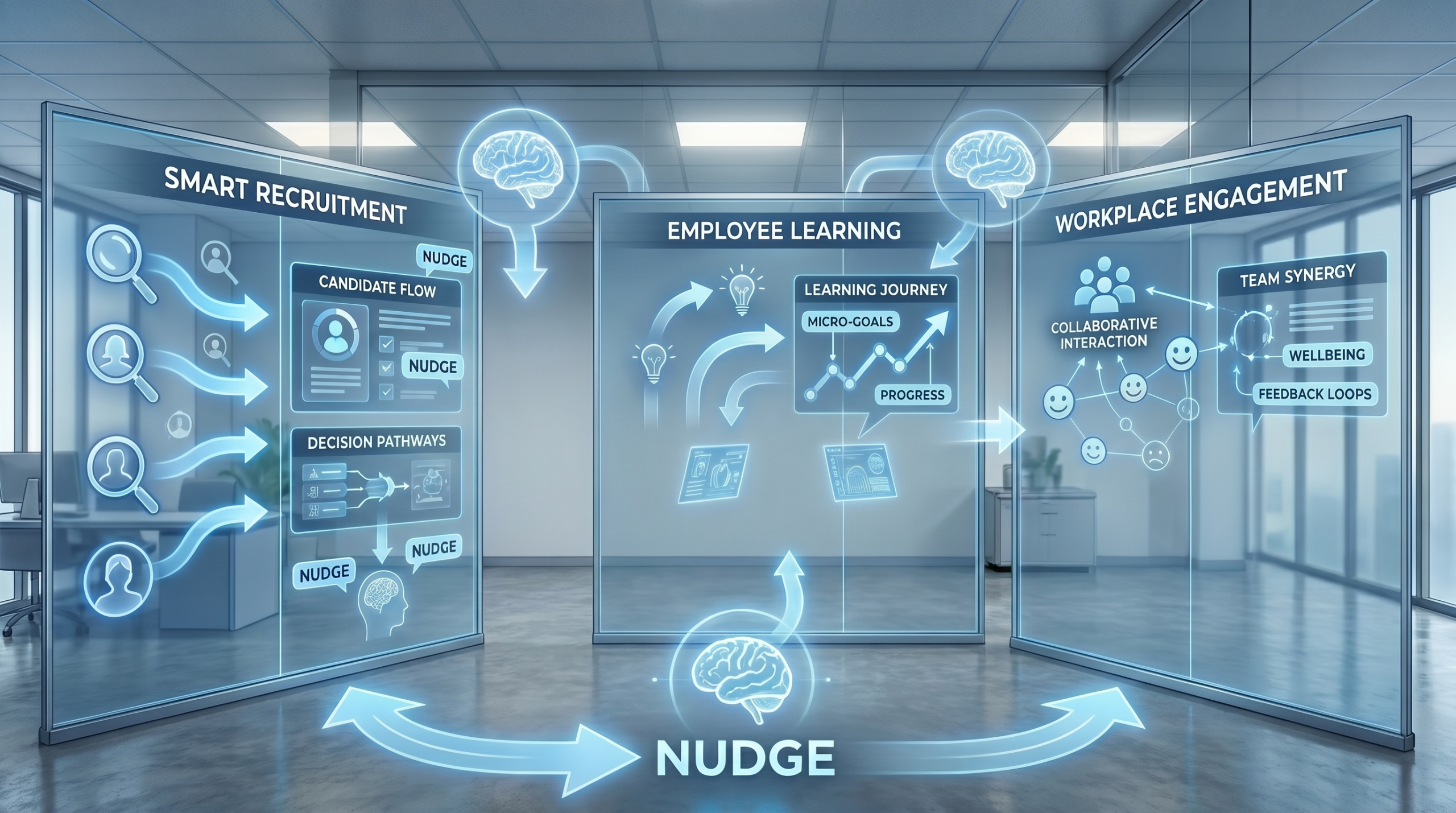
Before solutions, it helps to name the problem clearly. Behavioral breakdowns in HR tend to cluster around three areas:
- Hiring:
Unconscious bias, inconsistent evaluation criteria, and poorly structured application journeys lead to missed talent and poor cultural fit issues that recruitment automation alone cannot fix without behavioral design underneath it. - Learning:
Employees forget up to 70% of new information within 24 hours without reinforcement. Employee learning initiatives that lack follow-up nudges rarely translate into behavior change. - Engagement:
Disengagement does not happen in one moment. It accumulates quietly through missed recognition, unclear goals, and a lack of meaningful feedback areas where employee engagement programs often intervene too late.
Across all three areas, the pattern is the same. The systems exist, the intentions are right, but without a behavioral layer guiding how people experience those systems, the gap between what HR designs and what employees actually do remains wide open.
Nudging the Hire: How Small Cues Shape Better Recruitment
AI in recruitment has opened new possibilities for behavioral design in the hiring process. But the technology only works when the human behavioral layer is considered alongside it.
Effective nudges in recruitment include using inclusive language in job postings to attract broader talent pools, structuring application steps so candidates are guided rather than overwhelmed, and designing interview processes that reduce evaluator bias through consistent scoring frameworks. These are not radical changes, they are deliberate ones.
A well-designed talent management strategy considers not just who to hire, but how the hiring experience itself communicates organizational values. Candidates make decisions based on how the process feels, not just what the offer letter says.
Learning That Actually Sticks
The challenge with employee training programs is rarely content quality. It is a transfer. People leave a session informed and return to a workflow that makes the old behavior easier than the new one.
Nudge theory addresses this through:
- Defaults:
Auto-enrolling employees in follow-up sessions rather than making attendance optional - Reduced friction:
Delivering bite-sized employee development content within tools people already use daily - Commitment prompts:
Asking employees to name one behavior they will apply in writing, publicly immediately after a session - Timed reinforcement:
Scheduling follow-up nudges two to four weeks post-training, when behavior is most at risk of reverting
When nudges are built into the learning journey, training stops being an event and starts becoming a habit. The goal is not to remind employees what they learned. It is to make applying it the path of least resistance. And that becomes most effective when employee performance tracking is centralized, making it possible to detect drops in productivity early and respond with the right intervention before the behavior reverts.
Engagement Is Built in Moments, Not Milestones
Employee engagement strategies often focus on big moments, annual surveys, town halls, recognition events. Nudge theory suggests the real work happens between those moments.
A manager nudged to check in after a difficult project, an employee prompted to update goals after a team shift, a peer recognition system that makes appreciation the default rather than the exception these micro-moments build or erode engagement over time. Employee engagement activities embedded into daily rhythms carry far more weight than those requiring people to opt in.
Employee KPI tracking becomes more meaningful when tied to these nudges not as surveillance, but as a feedback loop that helps people see their own progress in real time.
Making It Work: The Role of Smart HR Systems
Understanding nudge theory is one thing. Operationalizing it across an entire workforce is another. This is where HR technology earns its place not as a replacement for human judgment, but as the infrastructure that makes behavioral design scalable.
Centralized software like FlowHCM powered by AI features supports this by enabling timely nudges across the employee lifecycle from recruitment automation software that structures the hiring journey to prompts that keep employee performance management consistent year-round. The goal is not to automate HR. It is to remove the friction that prevents impactful HR practices from happening consistently.
Employee retention strategies built on behavioral design outperform those built on perks alone because they address why people disengage before it becomes a reason to leave. When HR systems carry the behavioral layer, the distance between intention and action gets shorter. And that gap is where organizational culture is actually built.