





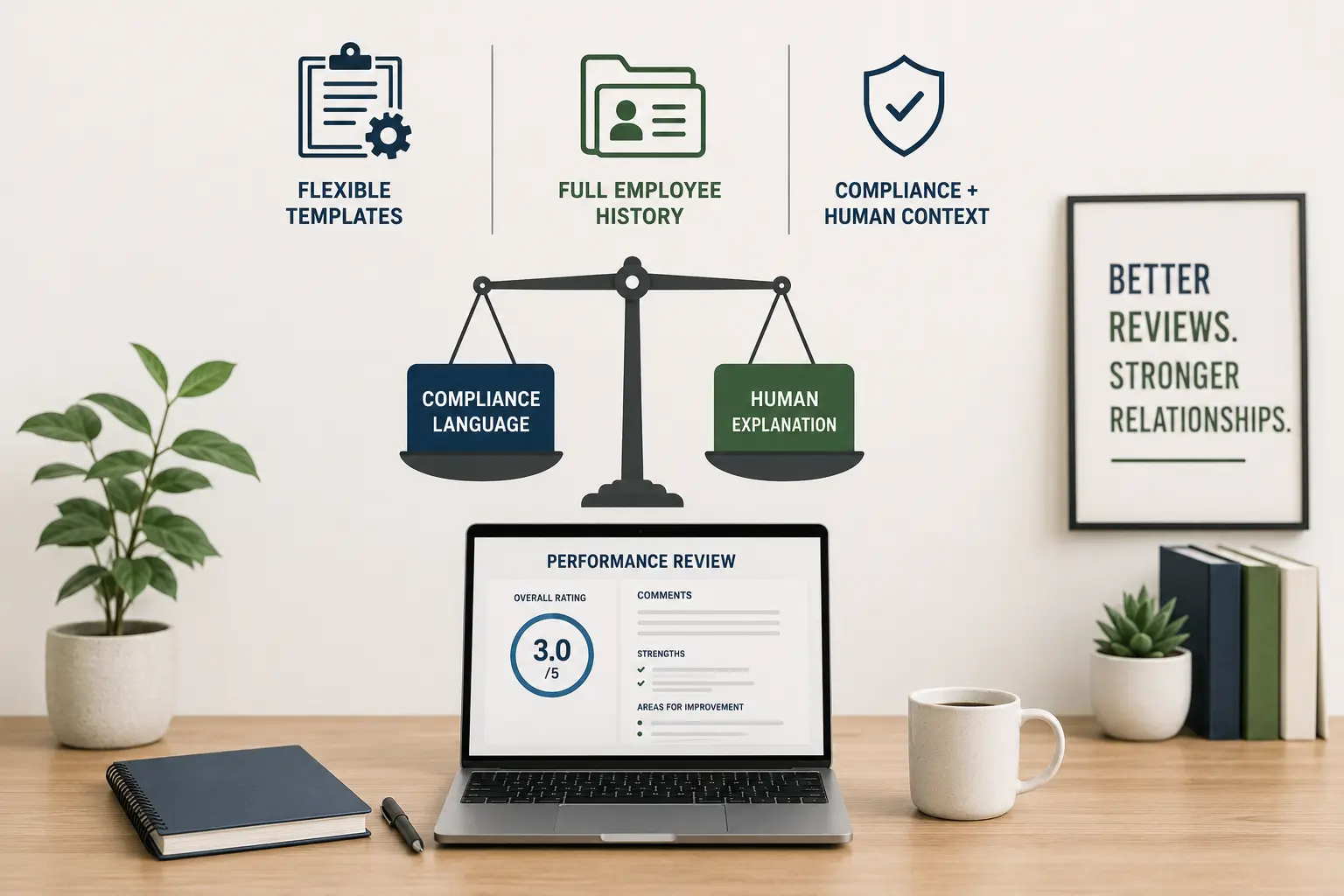
Emotional Intelligence in HR fails most often not because managers lack empathy, but because rigid, templated reviews and PIP letters strip out context and tone before the message reaches employees. This breakdown directly undermines employee performance management and retention strategies, as impersonal feedback erodes trust even when the manager’s intent is genuine. The fix is structural: flexible review templates, full employee history visible before scoring, and a clear split between compliance language and human explanation.
A dedicated manager spends months coaching an employee through a rough patch: regular check-ins, honest feedback, a real development plan. Then the employee’s performance review lands as a scored template with small room for any of that context. The number looks disconnected from the relationship it’s supposed to reflect. The system spoke before the manager could make an actual assessment.
This happens constantly when the tools behind a review process prioritize consistency over accuracy. Even the most thoughtful manager can’t compensate for a review that arrives as a cold form letter, because by the time the employee reads it, the damage to their experience of the performance conversation is already done. The manager did the work all year. The paperwork just didn’t carry it.
The frustrating part is that nobody set out to make performance reviews feel this way. HR wanted consistent scoring. Legal wanted defensible language. Somewhere in that pursuit of standardization, the review stopped reflecting the manager’s actual judgment and started reflecting whatever the template allowed.
Why Emotionally Intelligent Managers Still Come Across as Cold
Emotional Intelligence in managerial situations is usually framed as a skill gap, something to be fixed with more empathy training. That framing misses where the actual breakdown happens. A manager can read a room perfectly, understand exactly what an employee needs to hear, and still watch that understanding flatten the moment it has to go through a fixed review template or a scored form.
The manager isn’t failing to connect. The system just isn’t built to let that connection reach the page. This is a design problem within performance management, not a personality problem within the manager.
Where HR Processes Quietly Strip Out Empathy
A handful of specific touchpoints inside the performance cycle are especially prone to this kind of flattening:
- Scored review templates. A fixed rating scale reduces a year of context and effort into a single number, with no space to explain what actually happened.
- Performance improvement plans. Legalistic PIP language makes a correctable issue feel like a countdown to termination, regardless of the manager’s actual intent.
- Warning and disciplinary letters. Standardized wording turns a specific, addressable problem into something that reads as final.
Individually, none of these feels dramatic. Together, they teach employees to distrust the entire performance management process, even when the managers running it are genuinely invested in their growth.
How This Undermines Employee Performance Management
When review moments feel templated instead of considered, employees stop engaging with the process itself. They notice quickly when a message lacks real thought, and once that happens, they stop trusting the accuracy of their own evaluation.
A review that reads like a checkbox exercise causes people to disengage from the feedback inside it. They stop acting on suggestions that they don’t believe accurately reflect them. What should function as a development tool turns into a source of quiet anxiety instead, something to get through rather than learn from.
This matters because performance management only works if employees believe someone actually paid attention to their year. A score delivered without context can’t carry that belief on its own. The manager’s judgment has to show up somewhere in the document, or the review stops functioning as a review and becomes paperwork instead.
There’s a cost on the manager’s side, too. When every difficult conversation runs through a fixed template, managers stop feeling like the person delivering an assessment and start feeling like the person forwarding something someone else has already decided. Companies invest in training managers to give thoughtful feedback, then hand those same managers a locked script for the exact moments that training was meant to prepare them for.
What This Actually Costs in Employee Retention
Unsatisfactory performance management delivery doesn’t stay contained to the review cycle. It directly weakens employee retention strategies. High performers expect their evaluations to reflect real judgment, not a generic scoring system. When they experience cold, templated feedback during pivotal moments, they start looking elsewhere.
This shows up as concrete loss: rising turnover among top performers, hesitation about internal moves because employees expect the same impersonal process, and fewer people willing to recommend the company to their networks. None of this appears on a dashboard labeled “templated reviews.” It shows up in exit interviews and in the slow decline of internal applications, well after the damage has already accumulated.
How to Rebuild Empathy Into the Process Itself
Fixing this means adjusting the workflow itself, not just training managers harder.
- Editable review and PIP templates. Replace static scoring language with flexible frameworks managers can adjust to reflect the actual situation.
- Manager visibility into employee history. Full context on tenure and prior performance prevents a review from reading like an isolated event.
- A clear split between compliance and message. Keep the required documentation separate from the human explanation, so one doesn’t compromise the other.
This is exactly where the right performance management setup earns its place. A system that lets managers adjust review language and pull in an employee’s full history before finalizing a score gives judgment somewhere to live. The scorecard stops being the whole story and becomes one part of it.
It’s worth being honest about something most conversations on this topic skip. A manager who struggles with a hard review looks identical, from the outside, to a manager who was handed the wrong tool for it. Training solves the first problem. It does nothing for the second, and most companies budget only for the first.
What a Well-Designed Performance System Looks Like in Practice
Modern performance management software should support a manager’s judgment, not flatten it. A well-designed setup lets managers customize PIP notices and warning letters so the language reflects the specific situation, not just the policy behind it, and surfaces tenure and performance history in one place so managers see the full picture before any formal review or notice goes out. Compliance stays intact throughout. Employees just receive something that actually reflects their year.
This distinction carries real weight. A manager who can open a review, see the employee’s history, and adjust the language to match the actual conversation sends something entirely different from one who forwards a locked scorecard. The compliance record looks the same either way. The employee’s experience doesn’t.
The One Habit That Signals a Company Takes This Seriously
Forward-thinking companies audit their performance review and PIP templates on a regular schedule, applying the same scrutiny they’d apply to any outward-facing communication. That habit only works when the underlying HR software actually supports editable workflows.
Training fixes individual behavior. Regular template audits fix the system behind it. The right performance management setup gives teams the tools to keep that system reflective of the people it’s meant to evaluate.
The next time a performance review goes out, it’s worth asking who actually shaped it: the manager who watched the work happen, or the template that never saw any of it.