


An HR compliance audit checks whether your employee records match labour law: contracts, attendance, overtime, payroll, and EOBI contributions. Audit-ready records are built monthly by reviewing one record type at a time, logging every fix and keeping proof in one place. In the Swiss cheese model, small gaps in hiring, time, pay, and filing records line up into costly findings. Closing them early keeps your HR team inspection-ready all year.
Inspectors rarely fail you for one missing file. They fail you for the pattern behind it. A single HR compliance audit can expose an absent contract, a late EOBI payment, and an unsigned overtime sheet in one afternoon, because the same weak habit caused all three.
Most Pakistani HR teams treat audit prep as a sprint. Files get chased in the final week, and gaps stay hidden until someone asks for proof. This article applies James Reason’s Swiss cheese model to HR records. You will see why failures happen in layers, how a monthly rhythm closes the holes, and which records an inspector asks for first. You also get a checklist grouped by record type that your team can start using today.
When Small Record Gaps Line Up, Audits Turn Costly
James Reason’s Swiss cheese model says failures happen when holes in several protective layers align. In HR, every layer has small gaps, and an audit finds the exact point where they meet.
Imagine a warehouse supervisor who joined without a signed appointment letter. His attendance sits in a paper register. His overtime comes from a spreadsheet nobody reviews. Each gap looks minor alone. Together, they leave you unable to prove what he worked or what he earned, which is the core of any labour law compliance dispute.
Your process has four layers, and each one leaks in its own way:
- Intake: contracts, CNIC copies, and appointment letters go missing.
- Time: shift logs and overtime approvals live in separate places.
- Pay: salary sheets change with no recorded reason.
- Filing: statutory submissions happen without proof of payment.
Strong HR documentation in even one layer can stop a failure from reaching the inspector. Weak employee records management across all four lets it through.
A Thirty-Minute Monthly Check Beats a Week of Panic
Pick one fixed date each month and review one layer of records at a time. Rotating through intake, time, pay, and filing means every layer gets checked each quarter, and nothing piles up.
Keep the review small. Sample ten files, compare them against your labour inspection checklist, and log what you fixed. That log becomes your audit trail, proof that you found gaps and closed them. Inspectors respect that evidence far more than a clean folder assembled overnight. It also turns employee records management into a shared habit instead of one person’s burden.
The HR Compliance Audit Checklist, Grouped by Record Type
A strong HR compliance audit covers four record types: hiring, time, pay, and filings. Use this as a labour inspection checklist and a statutory compliance checklist, one line per item.
Hiring and contracts
- Signed appointment letter for every employee
- Legible CNIC copy on file
- Probation and confirmation dates recorded
- Signed policy acknowledgment
Time and attendance
- Daily attendance logs for the full year
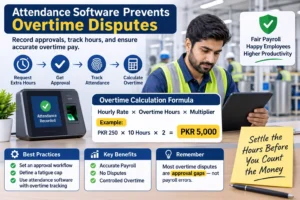
- Written overtime approvals matched to paid hours
- Leave balances reconciled monthly
- Shift schedules that follow working hours and overtime rules
Payroll and benefits
- Payslips issued each month
- Salary changes backed by signed approval
- Tax deductions matched to payroll
- Final settlement file for every exit
Statutory filings
- EOBI contributions paid on time, with proof
- Contribution challans stored together
- Provincial labour office registers current
- Inspector visit notes and replies saved
Where Software Takes Over the Heavy Lifting
Software helps by capturing records at the moment work happens, so nothing depends on memory. HR compliance software keeps documents, attendance, and pay in one place, with every edit timestamped.
That matters most in payroll. Reliable payroll software in Pakistan should calculate overtime from approved attendance, record each salary change, and flag EOBI due dates. FlowHCM payroll does this, and its attendance management feeds approved hours straight into pay runs. Fewer manual handoffs mean fewer holes to line up.
A tool will not fix a weak process, though. Build the monthly habit first, then let software hold it steady.
Audit Season Feels Calm When the Work Is Done Monthly
A strong HR compliance audit result comes from small, steady habits. Check one record layer each month, keep your HR documentation current, and log every fix. When one layer slips, the others still hold. That is the Swiss cheese lesson: you cannot remove every hole, but you can stop them from lining up.
FAQs
What is an HR compliance audit?
An HR compliance audit is a structured review of employee records against labour law and statutory rules. It checks contracts, attendance, overtime, payroll, and EOBI contributions for gaps and missing proof.
What records does a labour inspector check in Pakistan?
Inspectors usually ask for appointment letters, attendance registers, overtime approvals, payslips, and EOBI contribution proof. Keep each record type together so you can produce it in minutes.
Can payroll software in Pakistan help with an HR compliance audit?
Yes. Payroll software in Pakistan links approved attendance to pay, records every salary change, and stores contribution proof, which gives you a clean audit trail.