




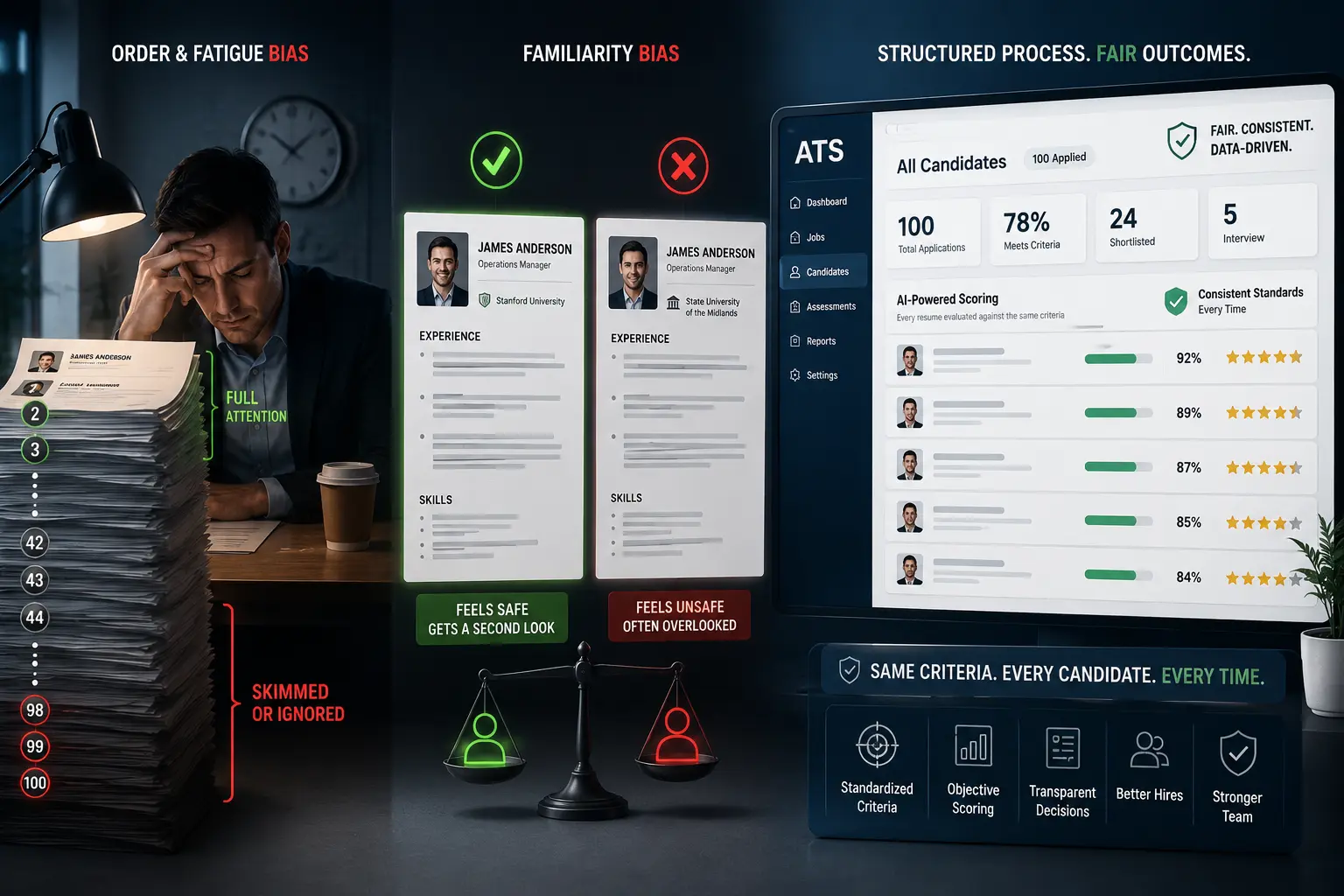
Resume screening bias rarely comes from a deliberate decision. It comes from how resumes get reviewed. Skim order favors the first few applications. Familiar-sounding names and schools get a second look that others don’t. Fatigue sets in late in a stack, and borderline candidates get rejected faster just to keep moving. An ATS resume tracking system removes these variables by standardizing how every resume is reviewed, scored, and routed, so outcomes depend on qualifications instead of when or how a resume was read.
Most hiring managers who screen resumes manually believe they’re being fair. They rarely see it happening, and the strongest candidate in the pile usually pays for it. Bias in manual resume screening rarely comes from a bad decision. It comes from how resumes are read, the order they arrive, and how tired the reviewer is by resume sixty. Nobody signs off on that outcome. It happens anyway, quietly, resume after resume, until a great hire never makes it past the first read.
Three mechanisms drive this: the order resumes are skimmed, the pull toward familiar names and institutions, and fatigue that lowers the bar for rejection. None of these appear in a hiring manager’s intent; they appear in the process, and the process runs the same way every single time unless something forces it to change. That’s why structure matters here: it changes how reviews happen, not who does them, and it leads directly into the first mechanism.
The Hidden Order That Decides Who Gets Rejected First
Resumes reviewed early in a stack get more attention than those reviewed after forty others. That’s the entire mechanism. It doesn’t require bias, just attention that fades as the pile grows.
A reviewer starts sharp and slows down quickly. By resume fifty, they skim for a reason to say no instead of yes. Qualified candidates who apply late or whose resumes land at the bottom of an unsorted folder take the hit.
- The first ten resumes usually get a full read.
- Resumes forty through sixty often get a six-second scan.
- Strong candidates get skipped because of when they applied.
- Nothing about qualifications changes between resume one and resume sixty; only attention does
Without a structured hiring workflow standardizing the queue, review order is left to chance, and that arbitrary sequence quietly decides who gets noticed. Applicant tracking software closes that gap by controlling how resumes enter the review process, which sets up the next source of bias: familiar names and schools.
Familiar Names and Schools Get an Unfair Head Start
A familiar name, a school the reviewer recognizes, or a former employer they’ve heard of creates a shortcut that feels “safe,” even when none of it relates to the role.
Picture two candidates applying for the same operations role with nearly identical experience. One lists a well-known university. The other lists a school the reviewer has never heard of. The recognizable name gets a callback. The other gets passed over, not because of a documented gap, but because one name felt safe and the other felt unfamiliar.
This shrinks the candidate pool to people who resemble the last hire. It repeats the same hiring pattern year after year and quietly filters out strong candidates who didn’t attend the “right” school or work at the “right” company. That pattern also links to another problem: reviewer fatigue. To catch it before it shapes the pipeline, HR recruiting software can flag it early. Automated recruiting software that scores candidates against defined criteria removes the shortcut before it forms, reducing fatigue.
Fatigue Doesn’t Announce Itself. It Just Lowers the Bar for Rejection
The later a resume is reviewed in a session, the more likely small, fixable issues like an employment gap or an odd format get treated as disqualifying.
By hour three of screening, a reviewer isn’t evaluating resumes on their merits. They look for the fastest reason to move on. That shift is why the fix isn’t asking reviewers to try harder. It’s giving them recruitment software that applies the same criteria regardless of stack position.
- Snap judgments replace careful reads.
- Identical qualifications get judged more harshly late in a session than early.
- A resume gap that would prompt a follow-up question at 9 a.m. gets an automatic reject at 4 p.m.
- The standard shifts throughout the day for reasons unrelated to the candidate. That drift is why the next step matters: applying the same criteria every time.
The Applicant Tracking System Ends the Stack Effect.
A structured application tracking system applies the same criteria to resume one and resume one hundred. That consistency removes order and fatigue as variables and resolves the issues described above. Screening doesn’t ask a tired reviewer to make a judgment call at 4 p.m. It applies the same scoring model to every application, whether it’s reviewed first or last, and keeps a record of why. That consistency leads to the final takeaway.
- Every resume gets scored against the same defined criteria.
- Shortlist criteria stay consistent no matter who’s reviewing or when
- Reviewers can see exactly why a candidate advanced, instead of relying on gut feel.
For teams juggling high application volume, HR recruiting software that automates scoring removes the guesswork entirely, standardizing the review process so screening reflects qualifications, not timing. That makes the final point simple: the process stays consistent from start to finish.
The Resume Screening Process You Can Actually Stand Behind
Order decides who gets a fair read. Familiarity decides who feels “safe.” Fatigue decides who gets the benefit of the doubt. That pattern leaves one clear conclusion: none of it has anything to do with who’s actually qualified. It has everything to do with whether the process is built to protect fairness. The answer is a structured screening process that keeps every candidate on the same footing from the start.
Consistent screening isn’t about good intentions. It’s about structure. Most reviewers don’t need better instincts; they need applicant tracking software that removes the variables instinct can’t control. A well-built resume tracking system doesn’t ask reviewers to fight fatigue or bias on their own. It removes the conditions that create them in the first place, so every candidate gets the same fair read. That is the standard worth standing behind.