




The inside of every modern organization does not always look the way it appears from the outside. A successful team, consistently meeting deadlines, collaborating well, and bringing new ideas to the table seems like a picture of workplace health. Yet a closer look tells a different story. A quiet dread has been settling into workplaces, not loud, not sudden, but slow and persistent, and very few are noticing it. Employees are still showing up, logging in, attending meetings, and sharing their perspectives, but somewhere in the middle of all that, a single question lingers: Am I falling behind? This is not burnout in the traditional sense. It is something more specific: a growing fear that the pace of technological change is outrunning their abilities, and in many cases, already has.
The complicated part is that employees themselves have not rejected technology. They have adopted AI tools, welcomed automation into their workflows, and leaned on platforms like ChatGPT, Claude, and Gemini to make their work easier. Yet that same adoption carries a quiet fear beneath it. The concern is not unfounded either. Several tech organizations have moved to replace parts of their workforce with AI agents for routine tasks, only to reverse course when those agents fell short on the human judgment and contextual thinking that the roles actually required. Still, the pattern left a mark. The wave of generative AI entering the workplace has become both an enabler and a source of anxiety at the same time, and employees are holding both of those realities simultaneously.
Organizations with experienced learning and development leaders are beginning to recognize what this actually means. The fear employees carry is not a personal struggle or an individual performance issue. It is a workforce wide crisis, and it is fundamentally reshaping how employee learning and development must function. This shift matters not only for existing employees who are navigating change mid-career, but also for new hires who enter organizations already carrying that same uncertainty and quietly expecting their employers to meet them with a clear, structured response.
The Quiet Crisis Spreading Across Every Workplace
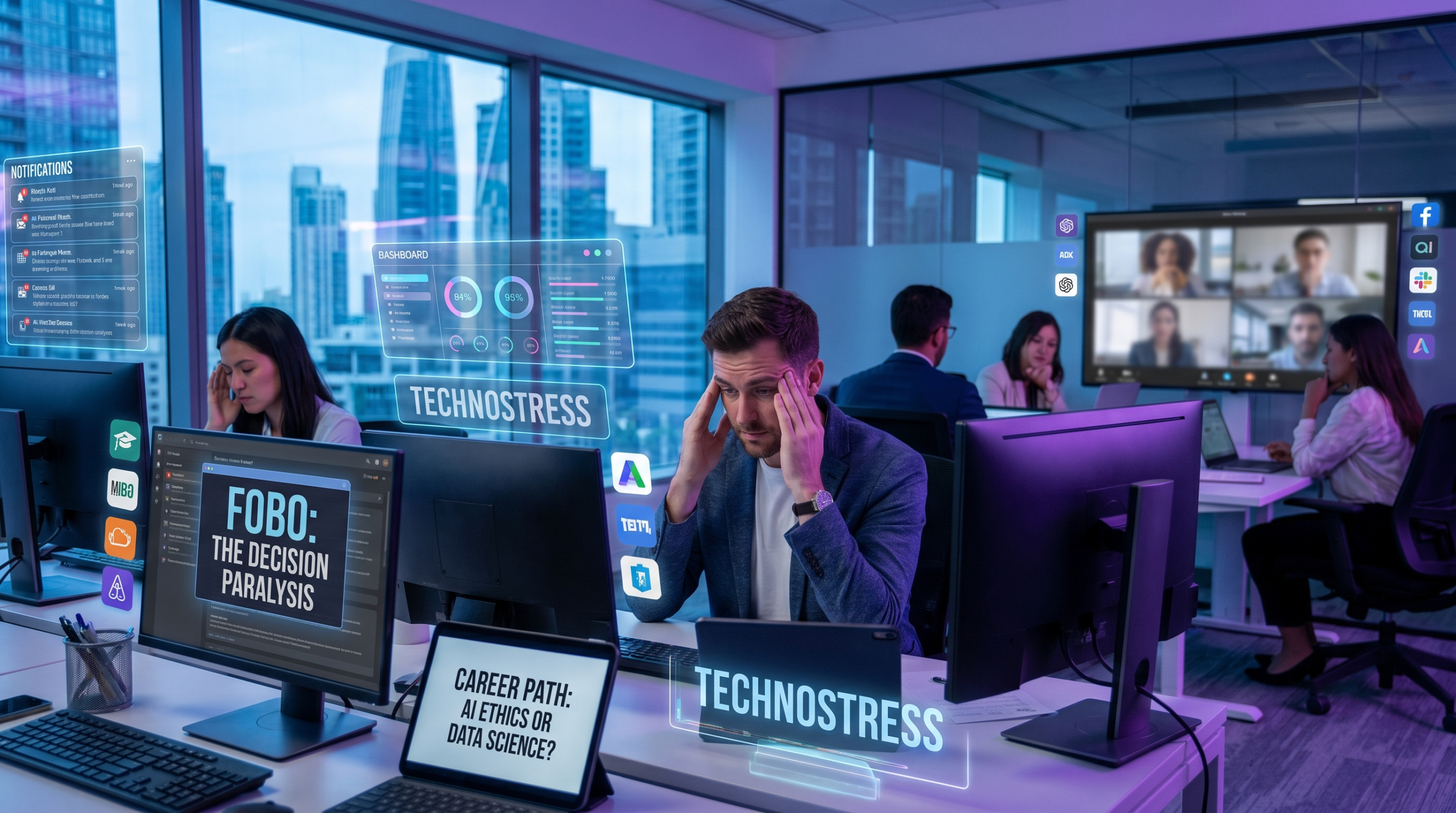
Two interconnected forces are changing the emotional landscape of work. The first is FOBO Fear of Becoming Obsolete. The second is Technostress, the psychological strain caused by constant pressure to adapt to new digital tools and systems faster than one can meaningfully absorb them.
FOBO is no longer a fringe anxiety. Gallup research shows the fear of technology making jobs obsolete has grown sharply, with college-educated workers experiencing the steepest rise in concern. What was once associated with routine roles has moved firmly into knowledge work making employee upskilling and employee reskilling strategic necessities, not optional add-ons.
Technostress compounds this. When organizations layer in new platforms and automation faster than employees can adapt, the result is not agility it is overwhelm. Workers become less effective, and the gap between organizational expectation and individual capability quietly widens.
When the Fear of Obsolescence Becomes the New Normal
FOBO does not announce itself. It surfaces as disengagement, hesitancy to take on new responsibilities, and withdrawal from learning opportunities. As reported by Fortune, AI fluency is fast becoming a baseline requirement across industries and employees who sense this shift without structured support are left navigating it alone.
This has direct consequences for talent management strategy. Organizations that ignore FOBO find employee retention strategies increasingly difficult to sustain. High-potential employees do not stay where their growth feels uncertain. The fear of irrelevance quietly pushes talent toward organizations that visibly invest in development.
Generative AI is accelerating this urgency. Roles are not disappearing overnight, but they are transforming and the employees who thrive will be those whose organizations helped them evolve, rather than leaving them to figure it out independently.
Technostress: The Hidden Cost of Digital Overload
While FOBO is about the future, Technostress lives in the present. It builds when employees are expected to master new tools without adequate time, training, or context. Organizations navigating digital transformation often focus on implementation and efficiency gains and underestimate the human cost of that transition. Technostress manifests as:
- Reduced concentration and declining decision-making quality
- Growing resistance to adopting new systems and workflows
- Disengagement signals appearing across HR metrics dashboards
- Falling performance scores that employee performance evaluation processes eventually surface
Left unaddressed, Technostress erodes the very investment organizations make in digital transformation. The tools meant to improve productivity begin quietly undermining it.
What Happens When Organizations Ignore Both
When FOBO and Technostress are treated as individual problems rather than organizational ones, the consequences stack up fast. Workforce analytics consistently show that disengagement, low performance, and voluntary turnover cluster around periods of rapid technological change exactly when structured support is most absent.
The impact reaches further than team-level performance. Workforce planning becomes unreliable when skills gaps are not mapped proactively. Talent acquisition grows more expensive when retention falters. And employee engagement strategies lose momentum when the underlying anxiety about relevance goes unspoken and unresolved.
Structured Learning as the Real Antidote
Organizations managing this well share one common approach: they have made employee training and development a continuous, structured, and measurable function not a periodic event. Learning and development no longer operates at the edge of business strategy. It sits at the center.
Practical responses to FOBO and Technostress include:
- Conducting regular assessments to identify skills gaps before they become critical
- Building reskilling programs tied directly to technology changes happening within the organization
- Offering personalized employee benefits that include access to learning pathways and certifications
- Using workforce analytics to track the real impact of employee training programs over time
- Embedding employee learning into regular workflows so development feels continuous, not remedial
Turning Fear Into Forward Motion With Smarter Training Systems
Addressing FOBO and Technostress requires more than good intentions; it requires infrastructure. HR teams need systems that assess training needs, automate scheduling, track progress, and surface insights on employee talent management from one centralized place.
FlowHCM’s Training Management Software is built for exactly this, enabling organizations to plan, execute, and monitor employee training and development programs without the administrative weight that causes these initiatives to stall.
The future of work will not slow down. Employees experiencing FOBO need visible, consistent investment in their growth. When that investment is backed by the right systems, fear stops being a barrier and becomes the very thing that drives people forward.