





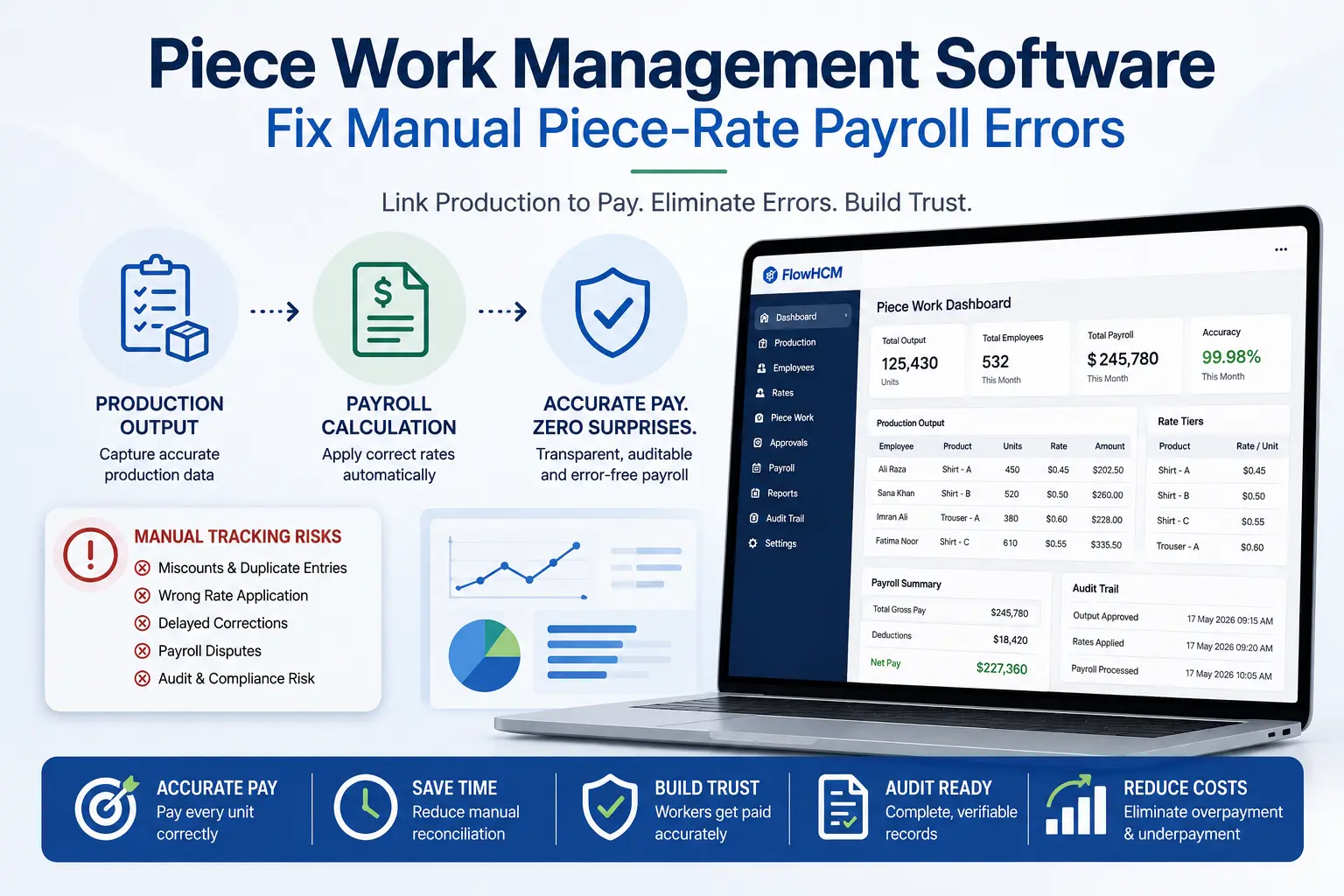
Manual piece-rate calculations create small, compounding payroll errors that go unnoticed until an audit exposes them. Piece work management software fixes this by linking production output directly to pay, applying rate rules automatically, and providing a transparent record of production and payroll calculations, reducing overpayment, underpayment, and the administrative time spent reconciling both.
A single miscounted batch on a factory floor rarely makes headlines. But multiply that error across hundreds of workers, dozens of shifts, and months of production, and you get a payroll problem that hides in plain sight. Most manufacturing and textile employers don’t discover how much manual piece-rate tracking is costing them until an audit forces them to look closely.
This is the operational vulnerability that Piece Work Management software was built to close. It automates output-based pay calculations, replacing spreadsheets and paper logs with a system that tracks production output and links it directly with payroll calculations.
Textile mills, garment units, and assembly-line manufacturers are especially exposed, since output volumes shift daily and pay rates often vary by product, grade, or shift. When that variability is administered manually, even a well-run HR team ends up reconstructing payroll logic from memory instead of relying on a fixed, auditable process. The result is a system that works most of the time, which is precisely what makes the failures difficult to detect.
The Structural Flaw Behind Manual Piece-Rate Tracking
Manual piece-rate tracking fails because it depends on people correctly recording numbers under time pressure, shift after shift. A supervisor rushing through a headcount, a slip of paper left in a pocket, or a rate table that wasn’t updated after a wage revision; any one of these creates an error that goes unnoticed until it’s compounded dozens of times over.
The danger isn’t that these mistakes are big. It’s that they’re small, repetitive, and invisible in day-to-day operations. Payroll looks “close enough” every cycle, so nobody questions it, until a reconciliation or audit adds up the gap.
Multi-rate environments make this worse. When a single production line runs several rate tiers for different products or skill levels, a manual system asks one person to hold all of those variables correctly in their head, shift after shift. One missed tier update, and every unit under that rate is miscalculated until someone notices.
The True Financial Toll of Manual Piece-Rate Errors
Manual piece-rate errors cost a factory in three ways: overpayment, underpayment, and the time spent untangling both. Overpayment quietly inflates labor costs without anyone flagging it as a problem. Underpayment creates a different kind of damage; it erodes trust and pushes skilled workers toward employers who pay them accurately.
The third cost is often the largest: administrative hours. HR and payroll teams spend disproportionate time cross-checking output logs against wage sheets, correcting disputes, and explaining discrepancies to workers who rightly expect their pay to match their output.
- Overpayment from duplicate or inflated output entries
- Underpayment from missed units, especially during shift handovers
- Rework hours spent reconciling logs after payroll has already run
- Worker disputes that consume supervisor time and damage morale
- Compliance exposure if wage records can’t be verified during an audit
The Silent Nature of This Payroll Leak
This problem remains hidden because piece-rate errors rarely show up as one dramatic failure. They accumulate gradually, cycle after cycle, in ways that don’t trigger an alarm on their own. A payroll report that’s off by a small percentage doesn’t look broken; it just looks like normal variance.
The other reason is ownership. Output data usually comes from the production floor, while pay calculations happen in HR or finance. When something doesn’t add up, it’s easy for each side to assume the discrepancy started with the other. Without a shared system connecting output to pay, nobody has full visibility into where the leak actually begins.
The Benchmark for Dependable Piece Work Management
Effective piece-rate management looks like a single, verifiable record that connects what a worker produced to what they were paid, without a manual handoff in between. Instead of output logs and payroll running as two separate processes, they operate as one continuous data flow.
A well-run system should be able to:
- Record production output for each employee or shift in a centralized system
- Apply the correct rate automatically, even across multiple product lines or rate tiers
- Review production records before payroll processing
- Give HR a clear audit trail for every pay calculation, without rebuilding it from scratch
When these pieces work together, payroll stops being a source of quiet loss and starts being a source of reliable, defensible data. Just as importantly, it stops depending on any single person’s memory of rate exceptions or shift-specific rules; the logic lives in the system, not in someone’s head.
Automation: The Definitive Fix for Piece-Rate Gaps
Automation closes this gap by removing the manual steps where errors are introduced in the first place. Rather than relying on someone to transcribe output totals and apply the correct wage rate by hand, the calculation happens the moment production data is logged.
This is the specific gap a dedicated piece work management module is built to address. It connects production output directly to payroll, applying rate structures automatically and keeping a clean record HR can trust without re-verifying every entry. For manufacturers and textile employers who’ve been absorbing the cost of manual tracking as a fact of life, that shift changes what payroll accuracy actually looks like day to day.
Teams evaluating a broader shift toward this kind of connected payroll system often find that piece-rate accuracy is rarely an isolated fix; it tends to expose gaps in attendance and scheduling data too.
Turning Piece-Rate Payroll Into a System You Can Trust
Manual piece-rate calculations don’t fail loudly; they fail quietly, one small discrepancy at a time, until an audit adds up the true cost. The fix isn’t more oversight or stricter manual checks; it’s removing the manual step altogether. When output and pay are captured in the same system, HR teams get accurate payroll, workers get paid the first time correctly, and audits stop turning up surprises.
That’s the real value of piece work management: not just automation for its own sake, but a payroll process that can finally be trusted at face value.