

A late attendance policy works best when consequences are small, certain, and quick. Set a written grace period, apply the same rule to every employee, and show the result within the same pay cycle. Employees accept a late attendance policy when they can predict the outcome and see it applied fairly. Heavy but delayed penalties create resentment. Mild and immediate ones change habits.
Every HR team knows the Monday morning scene. A manager reports that the same three people arrived late again. A warning gets drafted, then delayed, then forgotten. A month later, a salary deduction appears out of nowhere, and the argument begins. Nobody feels the rule was fair, and trust takes the hit.
The rule is rarely the problem. The timing is. A strong late attendance policy does more than list penalties. It applies to B.F.applies B.F. Skinner’s reinforcement theory, which says people change behavior when results follow quickly and predictably. Pakistani offices face real commute stress, from Karachi traffic to Lahore monsoon delays, so the policy must also feel reasonable. This guide shows HR leaders how to build one, with a sample clause and a simple good versus bad rule table.
The Penalty Nobody Connects to the Mistake
Late penalties fail when they arrive long after the lateness. Skinner showed that behavior changes when a consequence follows an action quickly and predictably. A deduction applied three weeks later feels like a surprise from HR, not a result of the employee’s own choice.
Three traits decide whether a consequence shapes behavior:
- Speed: the employee learns of the late mark the same day.
- Certainty: every late arrival gets the same response.
- Size: the penalty starts mild and rises with repetition.
Strict rules with slow follow-through teach nothing. Mild rules with fast follow-through teach a lot.
Building a Late Attendance Policy Around Consequence Timing
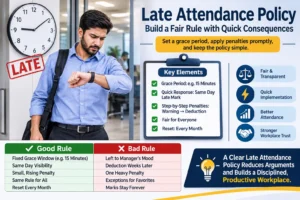
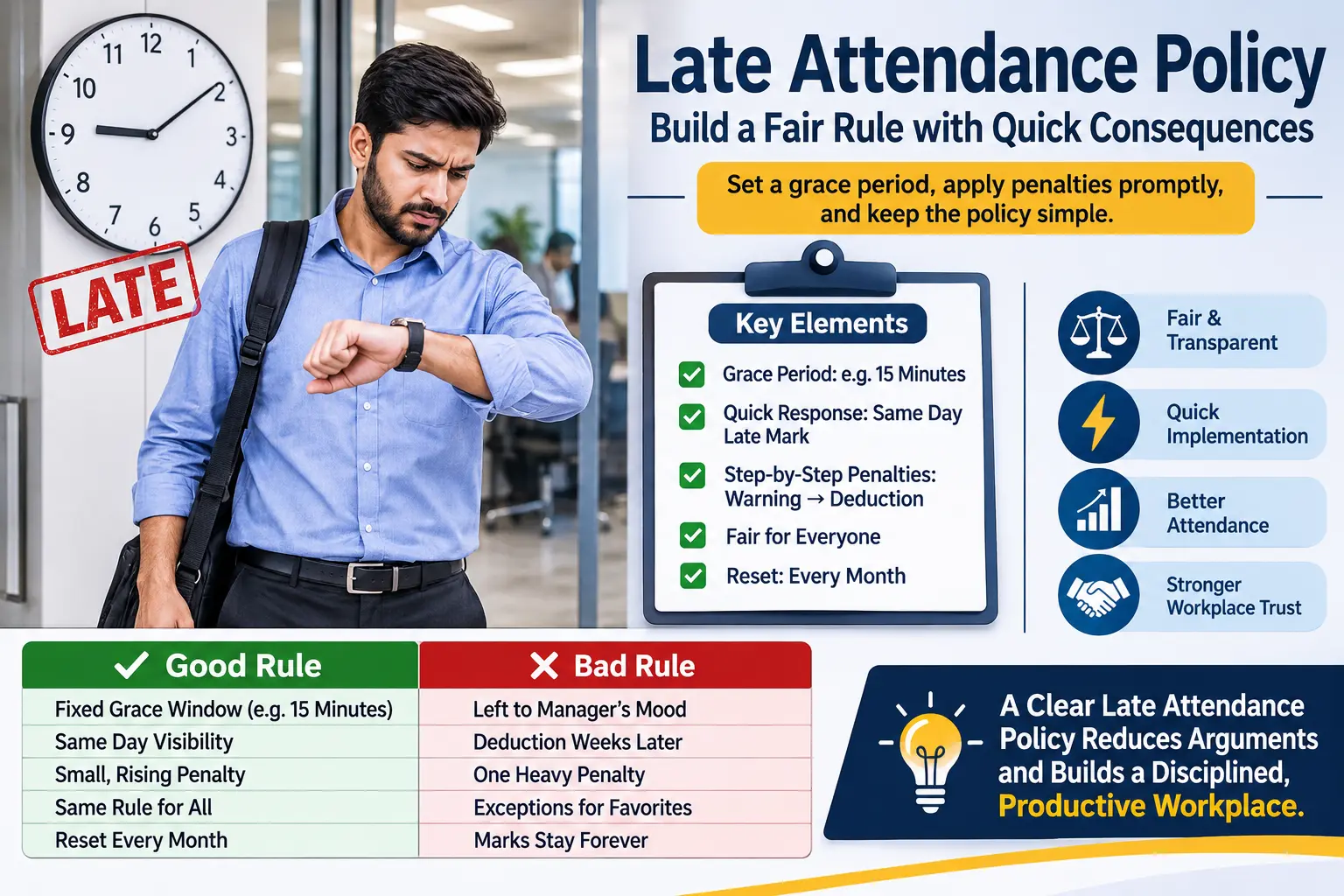
Build the late attendance policy so every late mark triggers a visible response within the same week. Start with a grace period policy that respects traffic without excusing habits. Many Pakistani offices allow 10 to 15 minutes, and the right number depends on your shifts and your location.
Then add a short ladder of steps:
- Same day: the system records the late mark, and the employee can see it.
- Same week: a running count appears on their attendance record.
- Third late mark: a private talk with the line manager.
- Fourth late mark: a small late-coming deduction, written down in advance.
Notice what is missing: surprise. Employees can predict every step, which is why they stop arguing.
The Clause That Ends Most Arguments
A clear late attendance policy clause states the number, the trigger, and the result, so nobody can debate it later. Use plain words and keep it short. Here is a sample you can adapt:
Sample clause
Employees may check in up to 15 minutes after shift startsstart without a late mark. Each later check-in is recorded as a late mark. Three late marks in one calendar month lead to a written reminder. Each late mark after the third leads to a deduction of one quarter day’s pay. Arrival more than two hours after shift start is treated as a half day. Late marks reset on the first day of each month.
Ask your legal advisor to check the final wording against your employment contracts and applicable labour rules before you publish it.
Good Rules Versus Bad Rules
A good rule is specific, predictable, and fast. A bad rule is vague, delayed, and uneven. Use this table to audit your current late attendance policy before your employees do.
| Element | Good rule | Bad rule |
| Grace window | Fixed and written, such as 15 minutes | Left to each manager’s mood |
| Consequence timing | Late mark visible the same day | Deduction announced weeks later |
| Penalty size | Small, rising step by step | One heavy penalty for any lateness |
| Fairness | Same rule from intern to director | Exceptions for favorites |
| Reset | Counter resets every month | Marks stay on record forever |
A Fair Exit for the Very Late Morning
Half-day rules should turn extreme lateness into a clean half day, so one bad morning is not punished again and again. The employee either uses half a day of leave or accepts a half-day deduction, and the choice is stated in advance.
Keep the rules short:
- Set one cutoff, such as two hours after shift start.
- Let employees use their leave balance first, when available.
- Allow documented emergencies, such as a medical visit, to bypass the count.
Fair exits like these protect good employees from feeling trapped.
Let the Data Flag It Before the Argument Starts
Reinforcement only works when the late mark appears at the moment of lateness, and paper registers cannot do that. A consistent late attendance policy needs consistent data. When records update in real time, employees see their own count without asking HR, and managers can plan shift coverage earlier.
FlowHCM connects attendance tracking with leave records, so a half-day conversion happens without a spreadsheet. HR then spends less time on disputes and more time on coaching.
Fair Rules, Fast Feedback
A late attendance policy earns acceptance when it is clear, mild, and quick. Write the grace window down, keep the first penalties small, and show every late mark on the same day. People rarely argue with a rule they can predict.
FAQs
What should a late attendance policy include?
A late attendance policy should include the grace window, the definition of a late mark, the escalation steps, the monthly reset, and a process for exceptions.
How long should a grace period be in Pakistan?
Most offices choose 10 to 15 minutes. No single number suits every employer, so match your grace period policy to commute realities and shift needs.
Is a late coming deduction allowed?
Often yes, when your contract and applicable labour rules allow it and employees were told in writing. Confirm with legal counsel before you apply any late coming deduction.
When does lateness become a half day?
Many employers set a cutoff of about two hours after shift start. Write your half-day rules into the policy so every manager applies them the same way.