





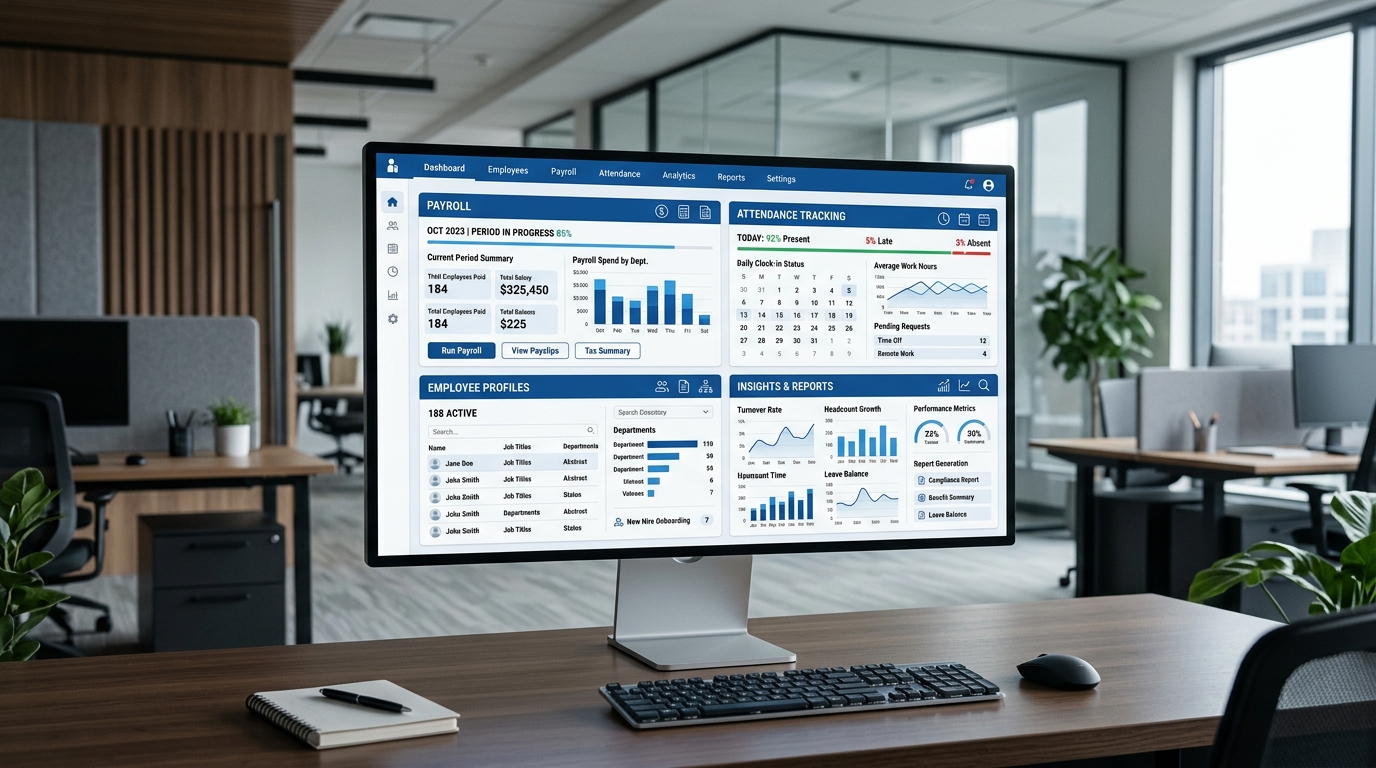
Most growing companies don’t need three separate tools for payroll, attendance, and employee records. HR Management Software unifies these functions into one system, removing the manual syncing that causes payroll errors and duplicate entries. Companies should consolidate when headcount, shift complexity, or reporting needs outgrow spreadsheets and disconnected tools. However, specialized point solutions can still outperform an all-in-one suite for one narrow function. The right HR Management Software platform gives every employee record one source of truth instead of three.
Ever notice how your payroll tool has no idea what your attendance system just logged? Or how someone updates their bank details in one place, but the other two systems never find out?
That’s the quiet tax every growing company pays for running payroll, attendance, and HR records as three separate tools. Nobody notices it on an invoice. It shows up as an extra hour of reconciling every Friday, a dispute over hours that don’t match, a manager pulling headcount numbers that don’t agree with anyone else’s. Eventually, you’re left with the same choice every growing team faces: keep juggling three specialized systems, or move everything onto one HR Management Software platform where the data has only one home. Here’s how to tell which one actually fits you.
Running Payroll, Attendance, and HR Records Apart Costs More Than It Looks Like
Three separate systems mean three logins, three vendors, and three places where an employee’s data can quietly go stale. When someone updates a bank detail in payroll but not in the HR file, disputes follow, and someone has to track down which version is correct.
Every additional HR Software tool you add creates a seam where information can fall through. The costs show up in places you don’t budget for:
- Duplicate data entry every time someone joins, leaves, or changes roles
- Payroll corrections that take days because attendance data arrived late
- Managers pulling different headcount numbers depending on which system they checked
- Compliance gaps when audit trails live in three places instead of one
None of this shows up on an invoice. It shows up in the hours your HR team spends fixing avoidable mismatches instead of doing higher-value work, which is the entire reason growing teams start shopping for consolidated HRMS Software in the first place.
One Unified Platform Solves More Than It Costs Once You Outgrow Spreadsheets
Consolidating onto a single HR Management Software platform makes sense once headcount, locations, or shift complexity have outpaced manual reconciliation. Below a certain size, three disconnected tools are annoying. Above it, they’re a liability.
The shift is straightforward once you see it in practice. Attendance tracking that feeds directly into payroll removes the manual matching step that swallows a full day every pay cycle. A true HCM Software platform ties time tracking, pay, and employee records into one file, so a change made once updates everywhere it needs to. That’s the promise most HRMS Software vendors make, though few actually deliver it end to end, which is exactly why the evaluation step below matters.
Separate Best-of-Breed Tools Still Win in a Few Specific Cases
Not every company should consolidate right away. If one function, usually attendance for a business with complex shift patterns or multiple pay rules, needs more depth than a general system provides, a specialized tool paired with a lighter HR system can outperform an all-in-one suite.
Some HR Solutions are built broad but shallow, trading depth in any one area for coverage across many. A niche tool can beat a unified platform on the single function that matters most to your business. The tradeoff only tips back toward one HR Management Software platform when the specialist tool can’t talk cleanly to payroll and records, and you’re back to manual reconciliation anyway, just with fewer systems involved.
What to Check Before You Consolidate
Before switching, map how data currently moves between your three systems and where it actually breaks down. The answer differs for every business, and guessing wastes migration effort.
Walk through these questions with whoever owns payroll and HR operations today:
- Where does duplicate entry happen most often, and who does it?
- Which monthly reports take the longest to reconcile, and why?
- What compliance rules require a single audit trail across pay and attendance?
- How many people touch payroll, attendance, and employee records every week?
The same logic applies whether you’re evaluating a dedicated HCM Software suite or a broader platform: match the tool to where your actual bottlenecks are, not to the feature list that looks most impressive on a sales call.
If the answers point to constant manual matching across systems, that’s your signal. Platforms such as FlowHCM are built as unified HR Solutions, so payroll, attendance, and employee records share one source of truth instead of living in three separate places that someone has to keep in sync by hand.
Fewer Systems Means Fewer Places for the Truth to Get Lost
The decision isn’t really about how many logins your team manages. It’s about how many places a single fact about an employee can live, and how often those places disagree. HR Software sprawl doesn’t cause errors on its own, but it multiplies the chances that one honest mistake turns into three conflicting records.
If your team is still reconciling payroll against attendance by hand, or chasing down which system has the current address on file, that’s the cost showing up in real time. HR Management Software built to unify these functions removes that friction at the source, and for most growing companies, that’s worth more than the flexibility of keeping three specialized tools running in parallel.