




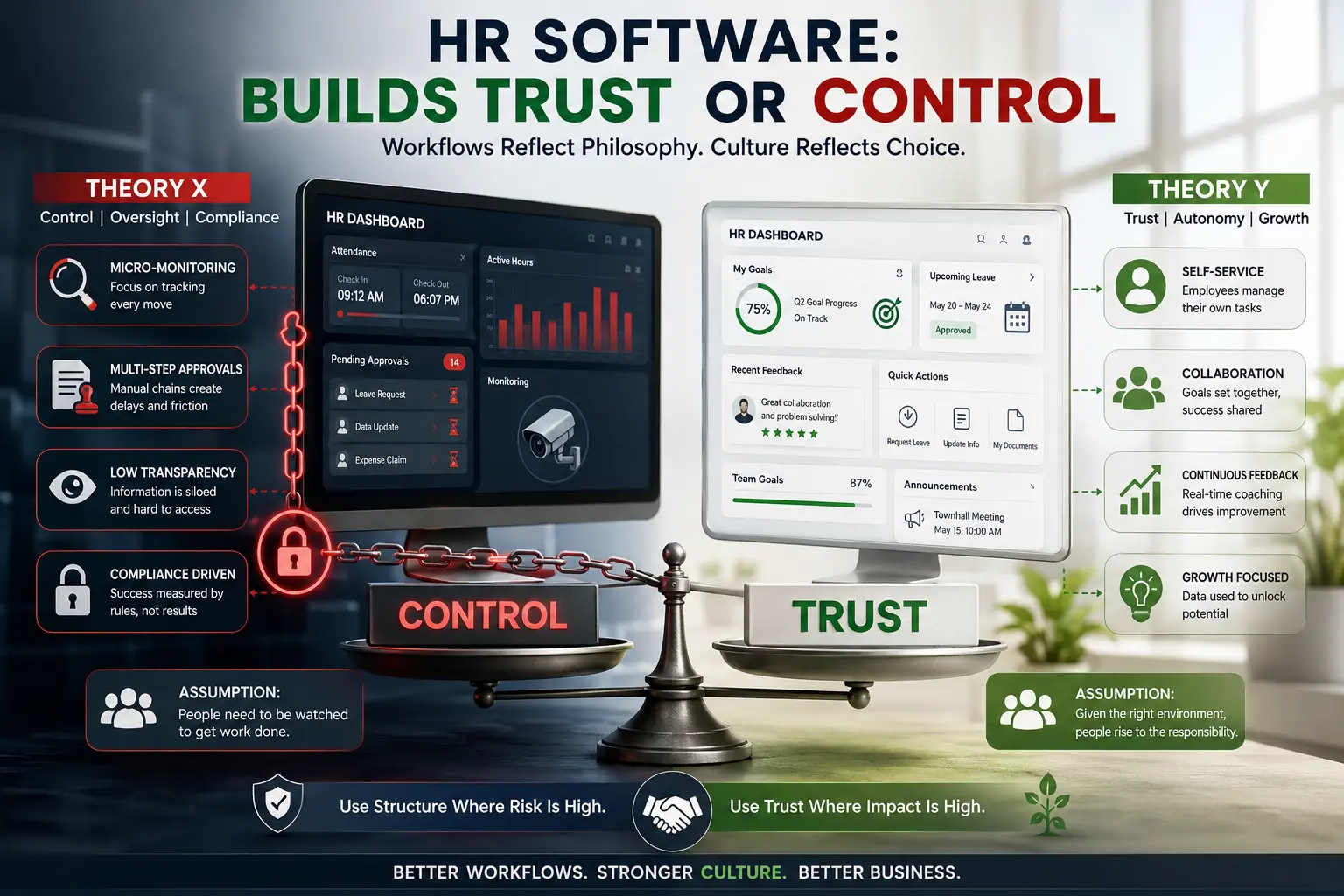
Whether HR software builds trust or control depends on how its workflows are designed, not on company intent. Theory X systems rely on monitoring and multi-step approvals; Theory Y systems use self-service, continuous feedback, and collaborative goal-setting. Good HR management balances both tight controls where compliance risk is high and autonomy everywhere else.
Every workplace operates on an underlying philosophy about people: either they need oversight to get work done, or they naturally rise to the responsibility they’re given. That philosophy shapes everything downstream, including the HR software a company chooses. A platform that requires multiple sign-offs for a minor data update, or tracks active hours instead of actual output, reflects one version of that philosophy. A platform built around self-service and shared goals reflects the other.
The software configuration directly shapes the employee experience by determining the administrative friction staff encounter in simple tasks. Choosing an open HR system that prioritizes transparent employee self-service options reduces these daily hurdles and allows team members to manage their professional data directly. This operational ease shifts the focus from administrative gatekeeping to professional empowerment.
Every HR system reflects an underlying philosophy about human behavior, whether leadership picked it on purpose or not. Psychologist Douglas McGregor coined these models back in the 1960s to illustrate the difference between control and autonomy. Spotting how these assumptions play out in your digital HR Management tools is the first step toward selecting technology that builds genuine corporate trust.
What Is the Fundamental Difference Between Theory X and Theory Y?
So what actually separates the two? One question settles it: does your business assume people need watching to perform, or that they do their best work once you hand over ownership? McGregor built this framework precisely to show how a leader’s private beliefs end up running the whole office.
Theory X, in short:
- Employees need continuous supervision to get through their workload
- Managers lean on rigid rules and active monitoring
- Success depends almost entirely on compliance
Theory Y, in short:
- Given the right environment, employees naturally push toward organizational goals
- Managers who promote open communication and professional autonomy get more ownership from their teams
- Shared responsibility, not top-down enforcement, is what drives organizational success
Why This Framework Still Matters Today
You can see this play out in ordinary HRM Software settings, where platforms quietly encode these assumptions into daily workflows nobody actually chose. Automate the oversight instead, and that freedom erodes fast. Teams end up in a Theory X setup nobody signed up for.
Does Your HR Platform Build Trust or Control?
Mostly it comes down to workflow design, not what leadership claims to believe. Talk flexibility all you want in the all-hands meeting, but if changing an address still needs three sign-offs, that’s the real message landing on employees’ desks.
| HR Function | Theory X Approach | Theory Y Approach |
| Attendance | Monitor only checks in and check-out times | Encourages individual accountability |
| Employees Goals Settings | Assigned top-down by managers | Created collaboratively through discussion |
| Employee Performance Feedback | A rigid annual evaluation | Continuous coaching |
| Leave | Manual approval chains | Automated employee self-service |
| HR Metrics & Analytics | Used to catch mistakes | Used to spot growth opportunities |
The takeaway: software doesn’t create trust or control on its own. The workflows you configure decide which one you get.
Signs Your HR Management System Leans Toward Theory X
You’ll notice the bottlenecks pretty quickly. Picture an employee emailing a leave request to their supervisor, who then sits on it waiting for three separate executive approvals. That kind of setup piles on tracking with almost no context, and it keeps employees at arm’s length from their own records.
Signs Your System Supports Theory Y
A trust-based system hands teams control over their own admin work. Employees submit and track time-off requests instantly through employee self-service. Managers get automatic updates instead of chasing paperwork. Dashboards remain transparent enough that people can manage their own data without first asking permission.
How Do Modern HR Platforms Support Theory Y?
Mostly by moving relevant employee data access away from gatekeepers and putting it directly in employees’ hands, while still keeping the accountability that operations actually need.
Employee goal setting builds ownership. Tracking a shared target makes the work feel personal and meaningful. Managers no longer need to spend hours chasing status updates, which frees up valuable time to focus on the bigger picture.
Performance reviews are no longer a once-a-year event. By the time you’ve waited twelve months to flag a problem, it’s already cost you something. Catch it early instead, and credit lands closer to when the work actually happened, which makes the year-end evaluation more honest, too.
AI plays a coaching role, not a surveillance one. Smart recruitment modules and automated chat assistants handle the heavy lifting of hiring and daily queries. This support lets managers step away from monitoring screens and fielding routine questions, so they can focus on resolving real operational roadblocks.
Are Theory X Managers Inherently Negative?
Not really. Most managers drift toward Theory X because the data isn’t there, not because they get a kick out of micromanaging. Society for Human Resource Management (SHRM) research backs this up, too, tying a lack of real-time visibility to a lot of supervisor anxiety and over-monitoring.
Take away reliable data on project progress or attendance, and that’s what a manager is supposed to do besides constantly asking for updates? Give that same person a clear, at-a-glance view of how things stand, though, and the urge to check in nonstop tends to fade on its own.
Can a Workplace Use Both Theory X and Theory Y?
Most successful organizations do, applying different levels of structure depending on the risk involved. Rigid, process-heavy tracking still makes sense for payroll, safety protocols, and financial compliance, areas where a slip-up creates real liability.
Creative or strategic roles work differently. Software development and design teams need room to make decisions on the fly, test ideas, and course-correct without waiting for approval at every step. This is where Theory Y fits, treating people as capable of managing their own judgment. The trick isn’t picking one theory over the other. It’s isolating the high-risk, compliance-heavy work within tighter Theory X workflows, while leaving everything else in the Theory Y room to breathe.
Which Management Style Is Better for Employee Retention?
Theory Y tends to win here, since people stay where they feel trusted, recognized, and able to grow. Gallup’s workplace research backs this up, showing that companies leaning into development-focused management see meaningfully lower turnover than highly controlled environments.
That said, autonomy without the right tools just turns into confusion. Teams still need a central place to check goals, request leave, and see peer feedback without having to go through the HR department for every little thing. Get that infrastructure right, and you can hold the line on standards while still giving people room to work independently.
What to Look for in HR Software That Builds Trust
The clearest signal is how deep the self-service options actually go. Look for employee self-service tools that let people initiate leave requests, update their own documents, and check performance milestones from their phone or desktop without waiting on anyone.
A few things worth checking for:
- Goal-ownership so that employees can update their own goals
- Continuous review cycles instead of annual check-ins
- Self-service access to historical records
- Reporting that’s actually easy to read
- Peer-to-peer feedback tools
- Analytics that surface skill gaps and workload strain early
How deep the employee goal-setting tools go is often the clearest signal of what a platform was really built for: access or approval. Getting this right usually means combining goal ownership, ongoing performance tracking, and self-service into one place, so accountability doesn’t come at the cost of autonomy.
Building a Culture of Trust
Technology doesn’t invent workplace culture. It amplifies whatever philosophy is already running the show. Choosing HR software built around visibility and ownership, rather than monitoring and approval, is the fastest way to close the gap between the trust a company claims to have and what employees actually feel day to day. Every workflow sends a signal; if you assume people need constant oversight, that assumption eventually becomes the culture, whether anyone meant it to or not.