





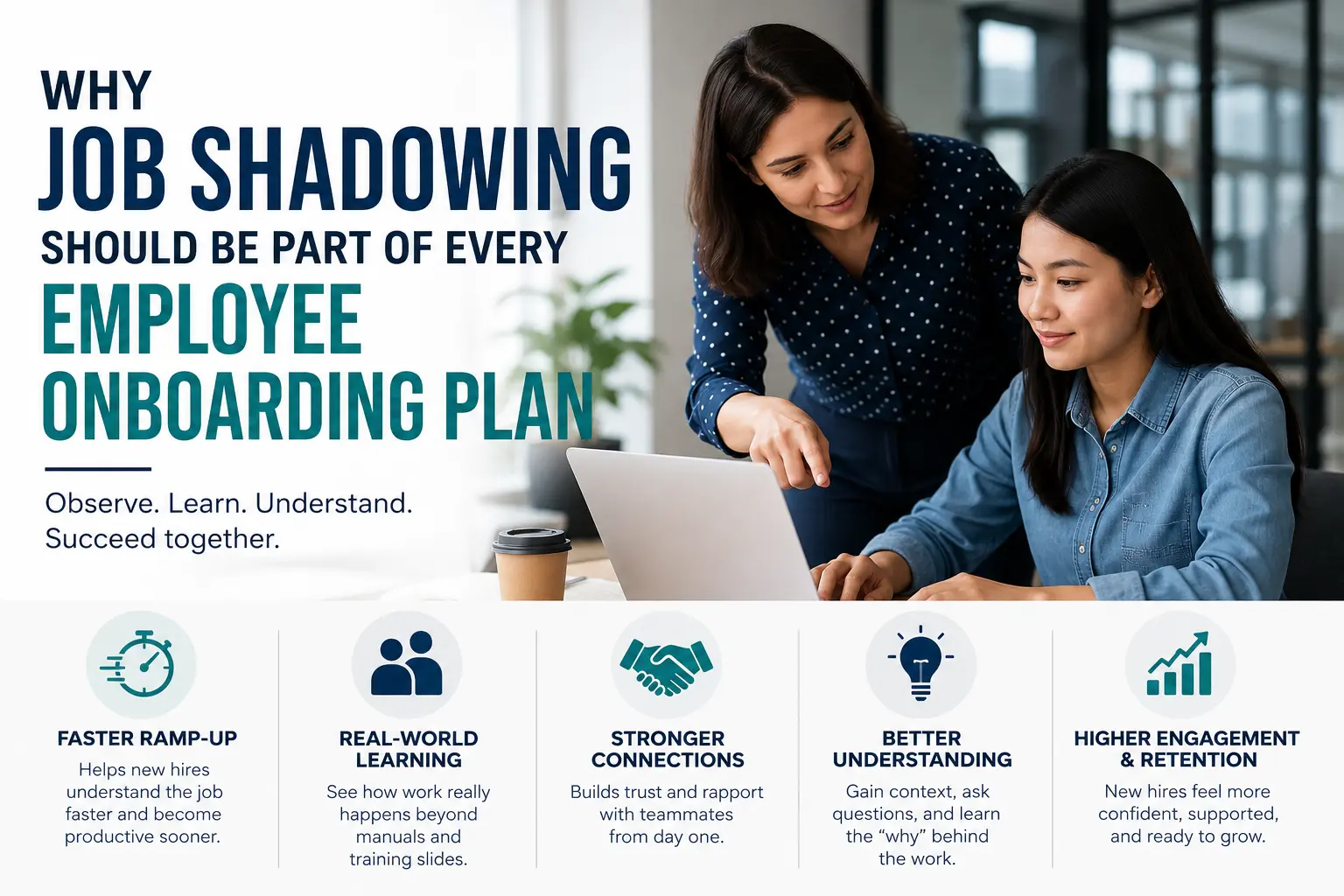
Whenever there is a discussion about an employee’s first day or their onboarding experience, certain things tend to come up repeatedly, like the gap between what the offer letter promised and what the real job actually feels like. The moment a new hire walks in, badges are waiting to be collected, forms are waiting for signatures, and a task list has often already been prepared for them. They are introduced to faces they were told to meet, sometimes without much context about who these people are or how they fit into the bigger picture.
Amid all of this first day activity, one thing usually goes unnoticed, not because it lacks importance, but because most new hires try to figure it out on their own instead of asking for help. It is a question most managers rarely address directly: what does the job actually look like once the training slides are closed and the checklist is complete? Once onboarding is technically finished and initial training has been delivered, how is a new hire really expected to carry out their day to day tasks?
This unspoken gap is exactly what job shadowing addresses in a way no handbook or training module can. It gives new employees a clearer picture of how work actually happens, not just how it is documented, and that is precisely why it deserves a permanent place in how organizations welcome new hires.
What Job Shadowing Actually Means in an Onboarding Context
Job shadowing, sometimes called work shadowing, is the practice of having a new or transitioning employee observe an experienced colleague as they carry out their regular responsibilities. Unlike mentoring, which centers on guidance and advice over time, or job rotation, which involves taking on new duties directly, shadowing carries no transfer of responsibility. The new hire watches, asks questions, and absorbs context without the pressure of performing the task themselves.
This distinction matters because it shapes how shadowing fits into employee onboarding. It isn’t a substitute for structured training programs, and it isn’t a performance evaluation in disguise. It’s a low-risk, high-context learning method that sits comfortably alongside other onboarding activities, adding a layer of real-world observation that documentation simply cannot replicate.
Types of Job Shadowing Worth Knowing About
Job shadowing isn’t a single fixed format. Depending on the role, team structure, and what the new hire needs to learn, it can take a few different shapes:
- Observational Shadowing:
The most common form, where the new hire simply watches a colleague work through their day without any hands-on involvement. This works well early in onboarding, when the goal is exposure rather than participation. - Hands-On Shadowing:
Once some familiarity is established, the new hire moves from watching to attempting small parts of the task themselves, under supervision. This bridges the gap between observation and independent work. - Job Rotation-Style Shadowing:
Instead of following one person, the new hire spends short periods across multiple roles or departments. This suits onboarding plans where understanding how teams connect matters as much as understanding one specific role. - Reverse Shadowing:
Here, the more experienced employee observes the new hire performing tasks and offers feedback in real time. It’s typically used a bit later in onboarding, once the new employee has had enough exposure to attempt the work themselves. - Cross-Departmental Shadowing:
The new hire shadows someone outside their immediate team to understand how their role fits into the bigger picture. This is particularly useful in functions that rely heavily on collaboration across departments. - Virtual Shadowing:
Conducted remotely through video calls or screen sharing, this format has become common for distributed teams, allowing new hires to observe workflows without needing to be physically present.
Most onboarding plans don’t rely on just one of these. A common approach is starting with observational shadowing, moving into hands-on or reverse shadowing as confidence builds, and adding cross-departmental exposure where the role demands broader context.
Why New Hires Need More Than Process Documents
Policy manuals and workflow diagrams tell a new employee what should happen. They rarely capture what actually happens when priorities shift, systems lag, or a colleague solves a problem that isn’t written down anywhere. That gap between documented process and lived practice is exactly where confusion tends to build during the first few weeks.
Watching an experienced teammate navigate their day gives new hires something more valuable than a checklist: judgment. They see how decisions get made under normal conditions, which shortcuts are acceptable, and which questions are worth asking before acting. This kind of contextual learning supports long-term learning and development far more effectively than a static onboarding deck, because it shows the informal rules that govern day-to-day work.
How Job Shadowing Speeds Up Time to Productivity
Every onboarding plan is ultimately judged by one measure: how quickly a new hire reaches full productivity. Shadowing shortens that timeline because it front-loads understanding instead of leaving new employees to piece things together through trial and error.
A few reasons this works consistently well:
- New hires spend less time guessing at tools, terminology, or internal processes because they’ve already seen them in use.
- Questions get answered in the moment, rather than piling up and slowing down actual output later.
- Employees gain a clearer sense of expectations early, which reduces avoidable mistakes in their first assignments.
This isn’t a claim that shadowing eliminates the learning curve altogether. It simply flattens it enough that new employees start contributing meaningfully sooner, which benefits both the individual and the team they’ve joined.
Building Trust and Team Connections Early
Onboarding isn’t only a technical process. It’s also a social one, and this is where shadowing quietly does some of its best work. Sitting alongside a colleague for even a few days creates a natural opening for conversation, questions, and the kind of rapport that doesn’t develop as easily in scheduled meetings.
New hires who shadow a peer tend to feel more comfortable reaching out later, because that first connection removes the hesitation that often comes with approaching someone unfamiliar. Over time, this contributes to a workplace where employees feel supported rather than isolated, which has a direct bearing on retention and morale well beyond the onboarding period itself.
Structuring a Job Shadowing Plan: Duration, Objectives, and Feedback
Shadowing works best when it’s treated as a deliberate part of the onboarding plan rather than an informal add-on. A few structural elements make the difference between a valuable experience and wasted time:
- Set a defined duration:
Open-ended shadowing tends to lose focus. A few days to a couple of weeks, depending on role complexity, usually strikes the right balance. - Establish clear objectives upfront:
Both the shadow and the host should know what the new hire is meant to take away from the experience. - Build in time for questions:
Passive observation alone isn’t enough; new hires need space to ask why something was done a certain way. - Close with a debrief:
A short conversation after shadowing ends helps convert observation into usable insight, rather than letting it fade as a vague impression.
Treating these elements as non-negotiable turns shadowing from a nice gesture into a genuine contributor to talent management strategy.
Common Pitfalls That Undermine Job Shadowing
Shadowing can fall flat when it isn’t planned with intention. A few recurring issues show up across organizations that treat it casually:
- Pairing new hires with colleagues who weren’t briefed on their role as a host, leading to disengaged or rushed sessions.
- Leaving objectives vague, so the new employee isn’t sure what they’re supposed to observe or learn.
- Scheduling shadowing too early, before the new hire has enough foundational knowledge to make sense of what they’re watching.
None of these problems are difficult to avoid, but they require the same attention given to other employee training programs. Shadowing without structure tends to produce lukewarm results, and lukewarm results are often mistaken for evidence that the method doesn’t work.
Making Job Shadowing a Measurable Part of Onboarding, Not Just a Checkbox
It’s worth resisting the temptation to include shadowing simply because it’s a familiar practice. Its value should be assessed the same way any other part of employee performance management would be reviewed. Comparing time to productivity, early performance review outcomes, or retention rates between employees who shadowed a colleague and those who didn’t offers a much clearer picture than assumption alone.
This measurement mindset also keeps shadowing relevant as roles evolve. As employee upskilling and reskilling needs shift, the structure of shadowing programs should shift with them, staying tied to real outcomes rather than habit.
None of this requires elaborate systems to get right, though HR teams managing onboarding, performance, and broader employee management processes often find it easier to track shadowing schedules, feedback, and outcomes when these sit within the same HR software they already use for other parts of the employee lifecycle, rather than as a separate, disconnected effort.
Job shadowing isn’t a trend borrowed from elsewhere in HR management; it’s a practical response to a problem every onboarding plan eventually runs into: knowledge that lives in practice, not paper. Giving new employees the chance to watch before they act may be one of the simplest additions an onboarding plan can make, and one of the most consistently useful.