





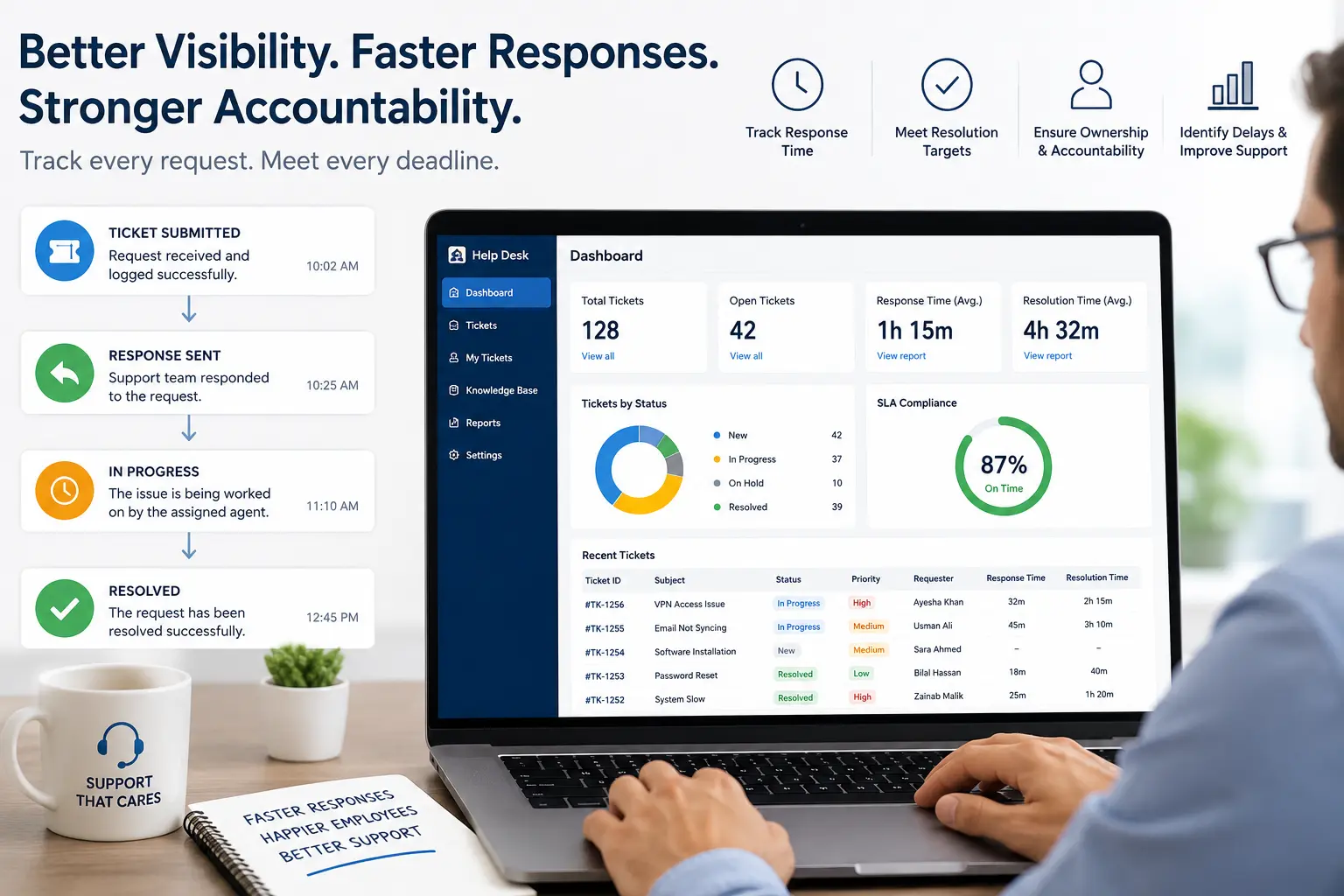
Support tickets don’t fail because people stop caring. They fail because no one is watching the clock. A request gets submitted, assigned, and then quietly ages in a queue while the employee waits, follows up manually, and eventually loses confidence in the process entirely. This is not a people problem. It is a visibility problem.
When support teams operate without defined time boundaries, delays become the norm rather than the exception. Employees have no way of knowing whether their request is being actively worked on or simply waiting. Support staff, managing multiple open tickets simultaneously, often lose track of which requests have been waiting the longest. The result is a support environment that feels unreliable even when the intent to help is genuinely there.
This is where response and resolution time visibility inside a helpdesk management system makes a measurable difference. It introduces time accountability into every ticket, from the moment it is submitted to the moment it is closed. Support teams gain visibility into what is on track and what is falling behind, while employees stay informed at every stage. The process becomes structured rather than reactive, and confidence in internal support begins to rebuild.
What Time-Based Tracking Means in Internal Support
Time-based tracking is often associated with Service Level Agreements (SLAs), which are commitments that define how quickly a support request should be acknowledged and resolved. In customer-facing environments, SLAs are typically contractual. In internal environments, such as those between employees and IT or HR support teams, they serve as operational standards that help keep workflows predictable and efficient.
Time-based tracking within a helpdesk system means that every submitted ticket carries a time expectation. The system helps teams track how long requests have been open, how quickly they are being acknowledged, and how long they take to resolve, giving managers better visibility into delays and unresolved requests. Without this layer, support managers rely on manual follow-ups or periodic reviews to catch delays, both of which introduce gaps.
What makes Time-based tracking particularly valuable in internal support is accountability at scale. When dozens of tickets are open simultaneously across IT, HR, and administrative teams, manual oversight becomes impossible. A structured helpdesk ticketing system replaces that with automated monitoring that works continuously in the background.
Response Time vs Resolution Time: Why the Difference Matters
These two terms are often used interchangeably, but they measure entirely different things.
A response time tracks how quickly a support team acknowledges a ticket after it’s submitted. This is the first touchpoint; it tells the employee that their request has been received and is being looked into. A delayed response does not necessarily mean the issue is unsolved; it means the employee has not yet received acknowledgment that the request is being handled.
A resolution time tracks how long it takes to fully close the ticket. This is the complete turnaround time from submission to solution.
Both matter because they capture different failure points:
- A team might respond quickly but then stall during investigation, leading to a long resolution time.
- A team might resolve a ticket efficiently but leave the employee waiting too long for an initial acknowledgment.
- Tracking only one gives an incomplete picture of support performance.
An effective helpdesk solution monitors both independently, so support managers can pinpoint where delays are actually occurring at the acknowledgment stage or the resolution stage.
How Helpdesk Software Improves Visibility into Aging Tickets
The most immediate value of time-based tracking lies in helping teams spot delays early rather than only reacting after requests have been waiting too long. A well-configured IT helpdesk system gives teams clear visibility into response and resolution times, making it easier to identify delayed requests, monitor progress, and keep both employees and support staff informed.
This typically works through a combination of:
- Status visibility:
Tickets are marked with clear stages such as New, In Progress, or Resolved, so both employees and support staff know where each request stands at any moment. - Email notifications and automated alerts:
Notifications are sent to the assigned agent and the submitter at key stages of the ticket lifecycle, including when a ticket is raised, when a response is logged, and when a resolution is entered. - Dashboard monitoring:
A centralized view displays all active requests with their current status, allowing support leads to spot aging tickets without opening each one individually. - Date-range filtering:
Managers can filter requests by submission date, status, or resolution time to surface patterns and identify which ticket types are consistently running late.
This kind of structured visibility is what separates a reactive support environment from a proactive one.
How Helpdesk Software Improves Ticket Ownership and Accountability
One of the most common breakdowns in internal support is ownership ambiguity. A ticket gets submitted, assigned, and then sits because the next action is unclear, the issue requires input from another team, or no one has clear visibility into where progress has stalled.
Helpdesk software improves this by making ticket activity visible throughout the request lifecycle. Each ticket carries a clear status, a record of who is involved, and a timeline of responses and updates. Instead of relying on scattered follow-ups or memory, support teams can see which requests are still open, who has interacted with them, and how long they have been waiting at each stage.
This matter because accountability is difficult to maintain when support work happens across inboxes, chat messages, and verbal follow-ups. A centralized helpdesk system creates a traceable record of the request from submission to resolution. Managers can review open tickets, identify where requests are slowing down, and follow up based on actual ticket history rather than assumptions.
For internal support teams, this kind of ownership visibility helps reduce stalled requests and creates a more reliable support process. Employees stay informed, support teams have a clearer view of pending work, and managers gain the visibility they need to improve follow-through across the helpdesk.
Reporting on Delayed Tickets and Where Bottlenecks Hide
Support data becomes most actionable when it’s aggregated. Individual ticket reviews reveal isolated delays; reporting reveals systemic ones.
A reliable desk help software generates reports that show:
- Which ticket categories take the longest to resolve
- Average response and resolution times across teams
- Resolution rates within defined time windows
- Ratings submitted by employees after a ticket is closed.
- Recurring issues that indicate a deeper operational problem rather than a one-off request
These insights allow support managers to make informed decisions, whether that means redistributing workload, identifying training gaps, or redesigning a support process that consistently produces delays. Bottlenecks in internal support rarely announce themselves clearly; they surface through patterns, and patterns require data.
What to Look for in a Helpdesk System That Supports Response and Resolution Tracking
Not every helpdesk solution is built with the same depth of Time-Based tracking support. When evaluating options, particularly for internal employee support rather than external customer service, the following capabilities define a system that can deliver real accountability:
- Ticket submission that captures all necessary details upfront without requiring technical knowledge from the employee
- Clear status stages that both the submitter and support team can follow in real time
- Automated email notifications at each key stage: submission, response, and resolution
- Dashboard access that gives a complete view of all open requests and their current state
- Resolution time and rating tracking that feeds into meaningful performance reporting
- Filtering and tracking by date range, status, and ticket type for operational review
FlowHCM’s Help Desk module supports many of the operational capabilities that strengthen request accountability in internal support, including centralized ticket management, status tracking, email notifications, response and resolution time tracking, ticket involvement visibility, and dashboard-based request monitoring. For organizations looking to bring more structure and visibility to employee support, these capabilities help reduce missed follow-ups, improve tracking, and keep requests moving more consistently.
For organizations where employee support still runs on informal follow-ups and scattered email threads, structured request tracking is not just a process improvement; it is a shift toward more reliable internal support. When every request has a visible status, recorded response and resolution times, and a traceable history, support becomes more consistent, transparent, and dependable for everyone involved.