




Hiring your first ten employees is nothing like hiring your hundredth. At the startup stage, every open role carries real weight a wrong hire can burn through budget, delay a product launch, or quietly damage team culture. The pressure to hire fast conflicts directly with the need to hire right. And most early-stage teams are navigating this tension without a proper system in place.
Most recruitment tools available in the market were designed for organizations that already have full HR departments, dedicated talent acquisition teams, and six-figure software budgets. They are built for scale, compliance, and complexity not for a founder who needs to fill three critical roles before next quarter. The gap between what enterprise recruitment software offers and what a startup actually needs is wider than most people realize.
So where does that leave the startup founder juggling three roles at once, trying to build a team that can actually execute? The answer rarely comes from spending more it comes from choosing smarter. Picking the right recruitment tool at the right stage is not a minor operational decision.
This is not just a technology question. It is a strategy question.
The Real Cost of Unstructured Hiring
Before diving into tools, it helps to understand what poor recruitment actually costs. Research consistently shows that the cost of a bad hire can range anywhere between 30% to 150% of that employee’s annual salary and that is before accounting for lost productivity, team disruption, and rehiring efforts. For startups operating on lean margins, these numbers are not just statistics, they represent real setbacks to growth and momentum. A single wrong hire at a critical stage can push a growing team back by months, not just budget lines.
Poor recruitment strategies do not just drain finances. They slow down growth, create team misalignment, and force founders back into reactive hiring mode. Structured recruitment backed by the right tools and the right process is not a luxury. It is a competitive advantage.
What Enterprise ATS Platforms Are Actually Built For
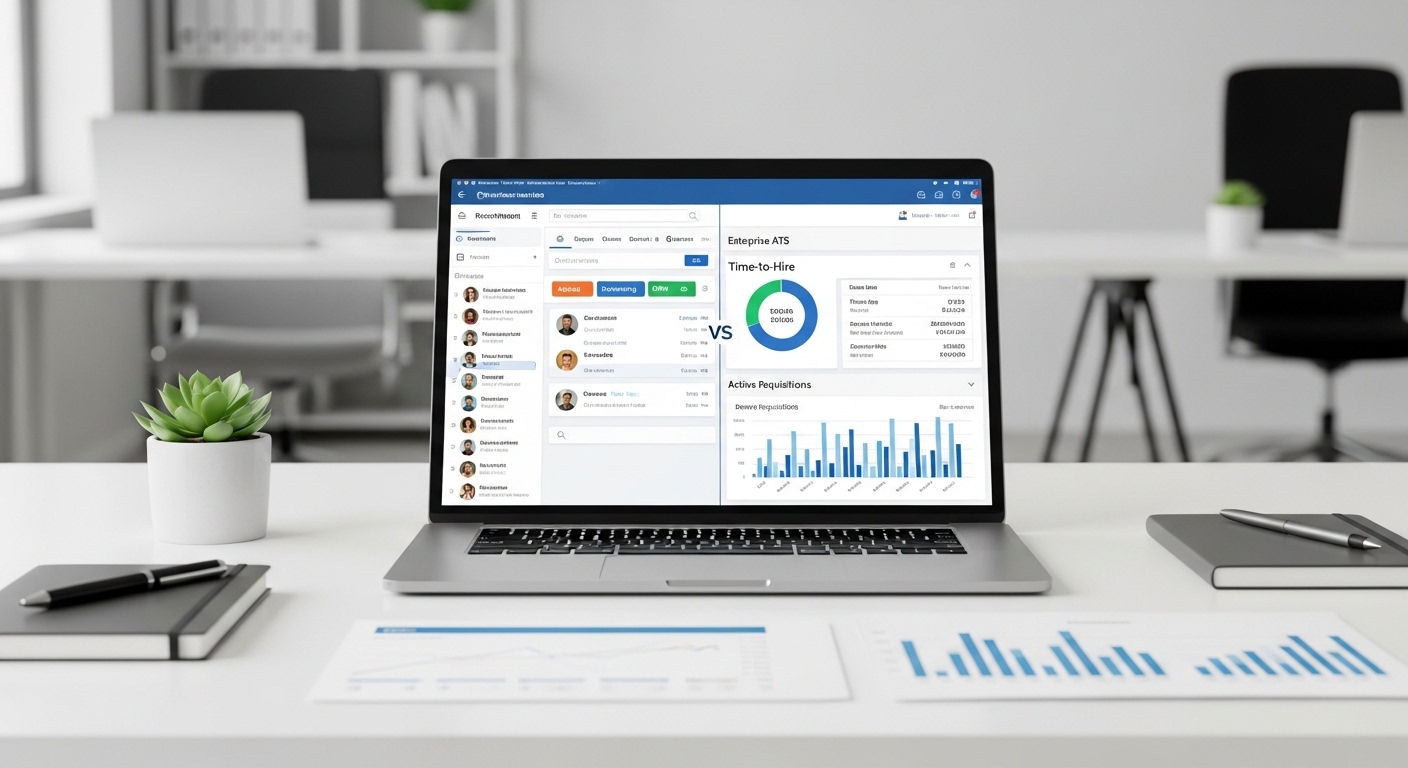
Enterprise ATS (Applicant Tracking System) solutions think platforms built for corporations with 1,000+ employees are engineered for volume, compliance, and deep customization. An ATS applicant tracking system at the enterprise level typically offers:
- Multi-country compliance management
- Advanced AI in recruitment for predictive candidate scoring
- Integration with hundreds of third-party tools
- Dedicated implementation and support teams
- Role-based access across large HR hierarchies
These are powerful capabilities. But for a startup with 20 employees trying to fill 5 roles, most of this architecture goes unused yet still gets paid for. Enterprise ATS platforms often come with long implementation timelines, steep learning curves, and pricing models that assume a large HR team will be managing the system daily.
The question is not whether enterprise ATS tools are good. They are. The question is whether they are right for where your business is right now.
The Global Market Shift Toward Smarter, Leaner Recruitment
The global recruitment software market has seen remarkable growth over the past few years, and projections suggest that momentum is only accelerating. A significant portion of this growth is being driven not by large enterprises but by small and mid-sized businesses finally investing in structured recruitment management. The market is expanding at a healthy CAGR, reflecting a broader shift in how organizations of all sizes are approaching talent acquisition. Affordable, capable recruitment tools are no longer a niche they are becoming the new standard.
Simultaneously, AI in recruiting automation is reshaping expectations across all company sizes. A 2023 LinkedIn Talent Trends report found that 74% of recruiters say AI and automation have already changed the way they work. Recruitment automation tools are no longer just enterprise features they are becoming standard expectations across the market.
This global shift signals something important: affordable recruitment software is no longer “basic.” Modern recruitment management systems built for growing businesses now offer capabilities that were exclusive to enterprise platforms just five years ago.
What Startups Actually Need From a Recruitment Tool
Startup recruitment strategy looks fundamentally different from enterprise hiring. Speed, simplicity, and visibility are the three pillars that matter most. A founder or HR generalist at a startup does not need a 40-page implementation manual they need a system that works on day one.
The core capabilities that actually move the needle for startups include:
- Structured job request and job posting workflows so open roles get approved and published without back-and-forth emails
- Candidate tracking from application to onboarding complete visibility at every stage without switching between tools
- Resume screening and shortlisting tools to quickly filter candidates without manually reading every application
- Interview scheduling and evaluation templates structured assessments that bring consistency to hiring decisions
- Recruitment analytics and dashboards to understand where candidates are dropping off and which sources are performing
Recruitment process automation within these core functions saves hours every week and significantly reduces the time-to-hire which, according to SHRM data, averages 44 days globally across industries.
When Recruitment Software Already Includes ATS The Either/Or Problem Disappears
Here is where many startups get stuck: they assume they need to choose between affordable recruitment software and a proper ATS tracking system. Either they invest in a lightweight tool that covers basic hiring workflows, or they stretch their budget toward an enterprise ATS application tracking system that does more than they need.
This is a false choice and modern recruitment management platforms have made it obsolete.
FlowHCM’s Recruitment Management Module is a practical example of how this integration works without friction. The module does not treat recruitment and applicant tracking as separate concerns. Instead, it covers the complete hiring lifecycle inside one unified system from Job Request and Job Post, through Screening, Short List, Schedule Interview, Evaluation, and all the way through Hiring Approvals and Recruitment Approvals. Every stage connects naturally to the next, which means HR teams and hiring managers always have full context without chasing updates across disconnected tools.
This kind of end-to-end recruitment management is exactly what growing teams need structured enough to scale, simple enough to use without a dedicated implementation project.
The Hidden Problem With Disconnected Tools
Many startups unknowingly build a recruitment tech stack that works against them. A job board account here, a spreadsheet tracker there, email threads for interview feedback, and a separate system for offer letters. The data lives in silos. Decisions get made on incomplete information. Candidates fall through the gaps.
Recruitment and retention are directly connected. Research consistently shows that candidates who experience a disorganized hiring process are less likely to accept offers and more likely to share negative impressions. A structured, responsive recruitment process is itself a branding tool in competitive talent markets.
Recruitment automation software that unifies these touchpoints does not just save time. It creates a better experience for candidates, which improves offer acceptance rates and strengthens the employer brand from the very first interaction.
How to Evaluate Recruitment Software as a Startup
Not every recruitment management system is the right fit. Before committing to any platform, startups should pressure-test it against these practical questions:
- Does it cover the full recruitment lifecycle from requisition to onboarding or only part of it?
- Can HR and hiring managers both use it without extensive training?
- Does it include built-in ATS applicant tracking system capabilities, or does that require a separate tool?
- What does the recruitment dashboard actually show vanity metrics or actionable data?
- How does it support recruitment and retention strategies beyond just filling roles?
The goal is a system that grows with the business. Recruitment needs at 30 employees look different from recruitment needs at 150. The right platform should handle both without requiring a complete migration.
FlowHCM: Recruitment and ATS Without the Trade-Off
For startups and growing organizations looking for a recruitment management system that does not force a compromise between affordability and capability, FlowHCM brings both into the same module. The platform’s recruitment module includes a structured workflow covering every stage of the hiring process with a recruitment dashboard, graphical and tabular reports, candidate database management, manpower requisition workflows, automated email acknowledgments, and flexible evaluation and interview templates that HR teams can configure without technical help.
The ATS functionality is not a separate add-on. It is embedded in the same pipeline, meaning candidate tracking, shortlisting, interview scheduling, and hiring approvals all live in one place. HR professionals get the visibility they need. Hiring managers get the collaboration tools they need. Leadership gets the reporting they need. All from a single recruitment management software platform.
Value Is Defined by Fit, Not Price Tag
The debate between affordable recruitment software and enterprise ATS is ultimately not about cost it is about fit. An enterprise ATS in the hands of a 15-person startup is often overkill. A lightweight tool without proper AI in recruitment features or structured workflows is a short-term fix with long-term consequences.
The startups that build strong hiring foundations early with structured recruitment strategies, proper automation in recruitment, and tools that give full lifecycle visibility are the ones that scale without the growing pains. Recruitment management is not a back-office function. For startups, it is one of the most strategic investments on the table.
Choose tools that match your stage, support your process, and grow with your ambition.