




The synchronization of employee attendance in real time has always been an ongoing challenge for organizations of all sizes. Employees forget to mark attendance, entries go missing even after punching in, and attendance data often shows incorrect records. All of these issues ultimately affect payroll. When employees start visiting their managers or HR personnel for attendance corrections, leave deductions, and expense adjustments, the workload becomes overwhelming. Without a connected HR system that links attendance data directly to payroll calculations, the entire process falls apart.
When this process runs through a manual lens, it creates delays, kills productive time, and leaves employees frustrated. Managers spend hours fixing discrepancies that should never have existed in the first place. The cost is not just financial but operational, as HR teams get buried in correction requests instead of focusing on work that actually moves the organization forward.
In 2026, these dynamics are changing rapidly. Organizations of all sizes are recognizing that time and attendance software is no longer a luxury but a necessity. Small businesses especially can no longer afford to treat attendance tracking as a back-office afterthought. The right system eliminates errors at the source, connects seamlessly with payroll, and gives both employees and managers the visibility they need to stay aligned without the back and forth.
The Hidden Cost of Manual Attendance Tracking
Manual attendance systems carry a cost that rarely appears on any balance sheet. On the surface, a shared spreadsheet or a paper register seems like a low-cost solution. Below the surface, it is one of the most expensive habits a small business can maintain.
The real damage shows up in several ways:
- Payroll errors caused by incorrect or missing attendance records lead to overpayments, underpayments, and employee disputes.
- Time theft and buddy punching go undetected when there is no system to verify who actually clocked in and when.
- HR hours wasted on manually compiling data, chasing approvals, and correcting errors every pay cycle.
- Compliance risks increase when attendance records are incomplete or inconsistent, especially during audits or legal disputes.
- Delayed decisions because managers have no real-time visibility into who is present, absent, or on a half-day.
For a small business running on tight margins and a lean HR team, these are recurring operational drains that quietly erode efficiency and profitability.
Why Small Businesses Are the Most Vulnerable
Large enterprises have dedicated HR departments, robust systems, and the budget to absorb inefficiencies. Small businesses do not have that cushion. A team of twenty to a hundred employees still demands the same level of attendance accuracy as a large corporation but with far fewer resources to manage it.
The challenge deepens as small businesses grow. What worked with ten employees becomes unmanageable with fifty. Shift scheduling grows complex, remote and hybrid arrangements add new tracking layers, and every attendance gap starts directly impacting output and team morale.
Small businesses also tend to lack dedicated IT support, which means any attendance solution needs to be easy to deploy, simple to use, and low on maintenance. This is exactly where modern employee time and attendance software closes the gap.
What AI Actually Changes in Attendance Management
Artificial intelligence is not just a buzzword attached to attendance software in 2026 it is actively changing how businesses understand and manage their workforce. Traditional attendance tracking software only shows late arrivals. AI-powered attendance management software goes deeper; revealing patterns, trends, and attendance behaviors that matter.
With AI embedded in time and attendance tracking software, small businesses gain the ability to detect patterns that would otherwise go unnoticed. Repeated late arrivals from a specific department, unusual absenteeism spikes before weekends, or overtime trends that signal understaffing these insights surface automatically without anyone digging through data manually.
AI also reduces human error at the point of entry. Automated approvals, smart alerts, and intelligent scheduling suggestions mean HR teams spend less time on administrative tasks and more time on decisions that move the business forward. The shift from reactive management to proactive workforce planning is one of the most meaningful advantages AI brings to attendance management software today.
Key Features to Look for in Time and Attendance Software
Not all attendance tracking software is built the same. For small businesses evaluating their options in 2026, the right time and attendance software should offer more than just basic clock-in and clock-out functionality. Here is what genuinely matters:
- Real-time attendance tracking accessible from mobile phones, tablets, and computers especially important for remote and field employees.
- Automated shift scheduling with support for daily, weekly, monthly, and yearly rosters, including department-wise and group-wise shift assignments.
- Employee self-service and manager self-service portals that reduce dependency on HR for routine requests like attendance corrections, shift changes, and exemptions.
- Comprehensive reporting with multiple attendance analysis; late arrivals, early departures, absenteeism summaries, overtime reports available at both employee and department level.
- Seamless payroll integration so that attendance data flows directly into payroll calculations without manual intervention, reducing errors and saving time.
- Cloud-based architecture that allows access from anywhere, scales with business growth, and requires no heavy infrastructure investment.
These features are not luxuries they are the baseline of what effective HR time and attendance software should deliver for small businesses.
How Cloud Based Time and Attendance Software Fits Every Work Style
The modern small business workforce is no longer confined to a single office. Teams are distributed, shifts are flexible, and work styles vary widely across roles and departments. Cloud based time and attendance software is built for exactly this reality.
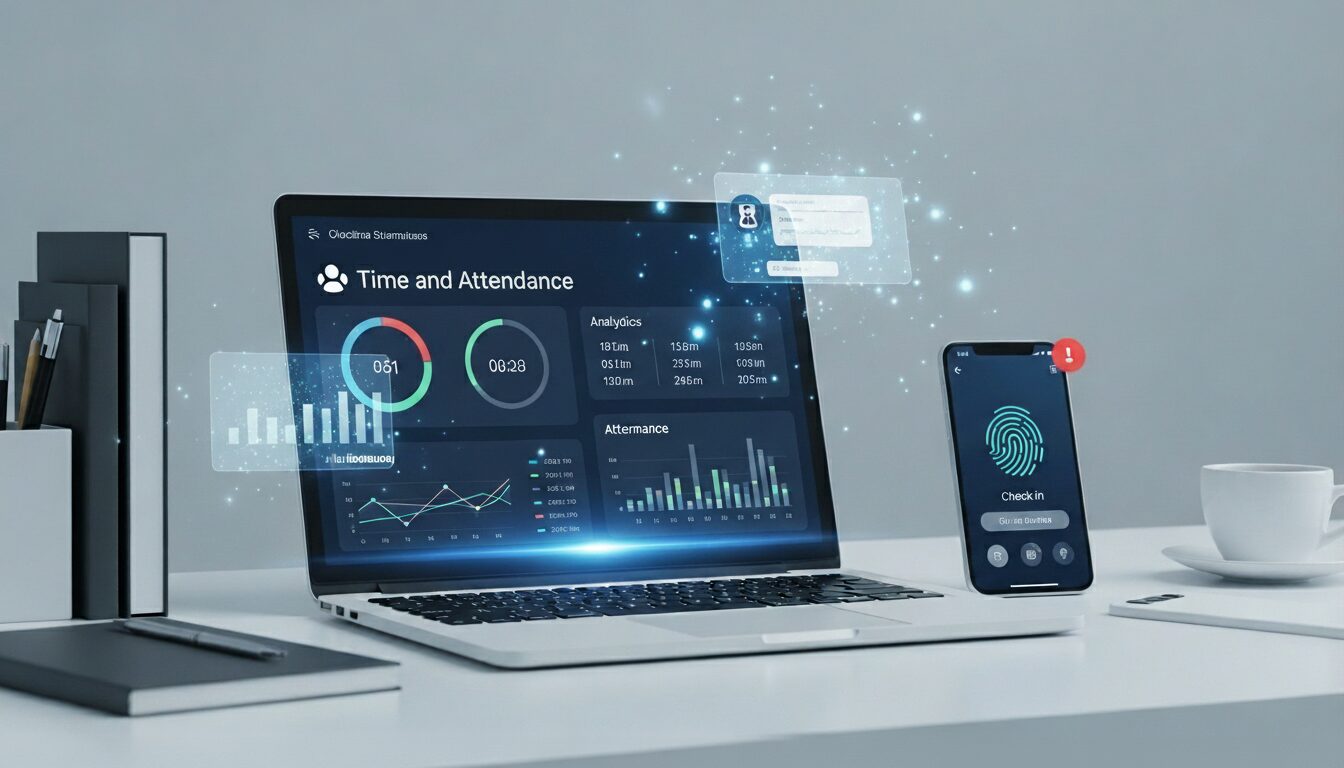
With a cloud-first approach, attendance data is captured and updated in real time regardless of where an employee is working. An onsite employee can check in through a biometric device. A remote employee can log attendance through a mobile app. A manager traveling for work can approve requests, review reports, and adjust schedules from any internet-connected device.
This flexibility matters enormously for small businesses that are growing, experimenting with hybrid models, or managing staff across multiple locations. Cloud based time and attendance software removes the geographic barrier from workforce management and puts accurate, up-to-date data in the hands of those who need it most.
How Small Businesses Can Simplify Attendance Management
FlowHCM’s Time and Attendance Management module brings order to the complexity that small businesses face every day. It is a one-window solution that combines a comprehensive attendance module with integrated hardware support, making it practical for businesses that need both simplicity and depth.
The module covers the full spectrum of attendance operations from attendance requests, shift transfers, and remote work requests to amendment handling, approvals, and scheduling. HR teams get access to more than twenty reports with detailed analysis and attendance trends, giving them the visibility to make informed decisions quickly.
What sets FlowHCM apart is its adaptability. Whether a business needs employee-wise tracking, department-wise reporting, or group-based shift management with Excel upload support, the system accommodates it without custom development. The self-service portal further reduces HR workload by empowering employees and managers to handle routine attendance tasks independently making it a genuinely practical choice for growing small businesses.
The Real ROI for Small Businesses in 2026
Investing in time and attendance cloud software is not an expense it is a decision that pays back in measurable ways. Small businesses that make this shift consistently report:
- Significant time savings as HR teams move away from manual data compilation and error correction.
- Higher operational efficiency through accurate shift planning, reduced absenteeism, and better resource allocation.
- Lower operational costs from eliminating payroll errors, time theft, and compliance risks.
- Smarter decision-making backed by real-time data and AI-generated attendance insights.
- Better workforce planning that helps small businesses scale without losing visibility or control.
For small businesses in 2026, the question is no longer whether to adopt time and attendance cloud software, but how soon. Every day spent on manual processes is a day of lost productivity, avoidable errors, and missed opportunities to grow smarter. The businesses pulling ahead are not necessarily the ones with the biggest teams or the largest budgets; they are the ones making better use of the tools available to them.
Time and attendance software is no longer a luxury reserved for large enterprises. It is a practical, affordable investment that delivers returns from the very first payroll cycle. Small businesses that act now position themselves with a stronger operational foundation, a more engaged workforce, and the kind of data-driven confidence needed to compete and scale in an increasingly demanding market.