





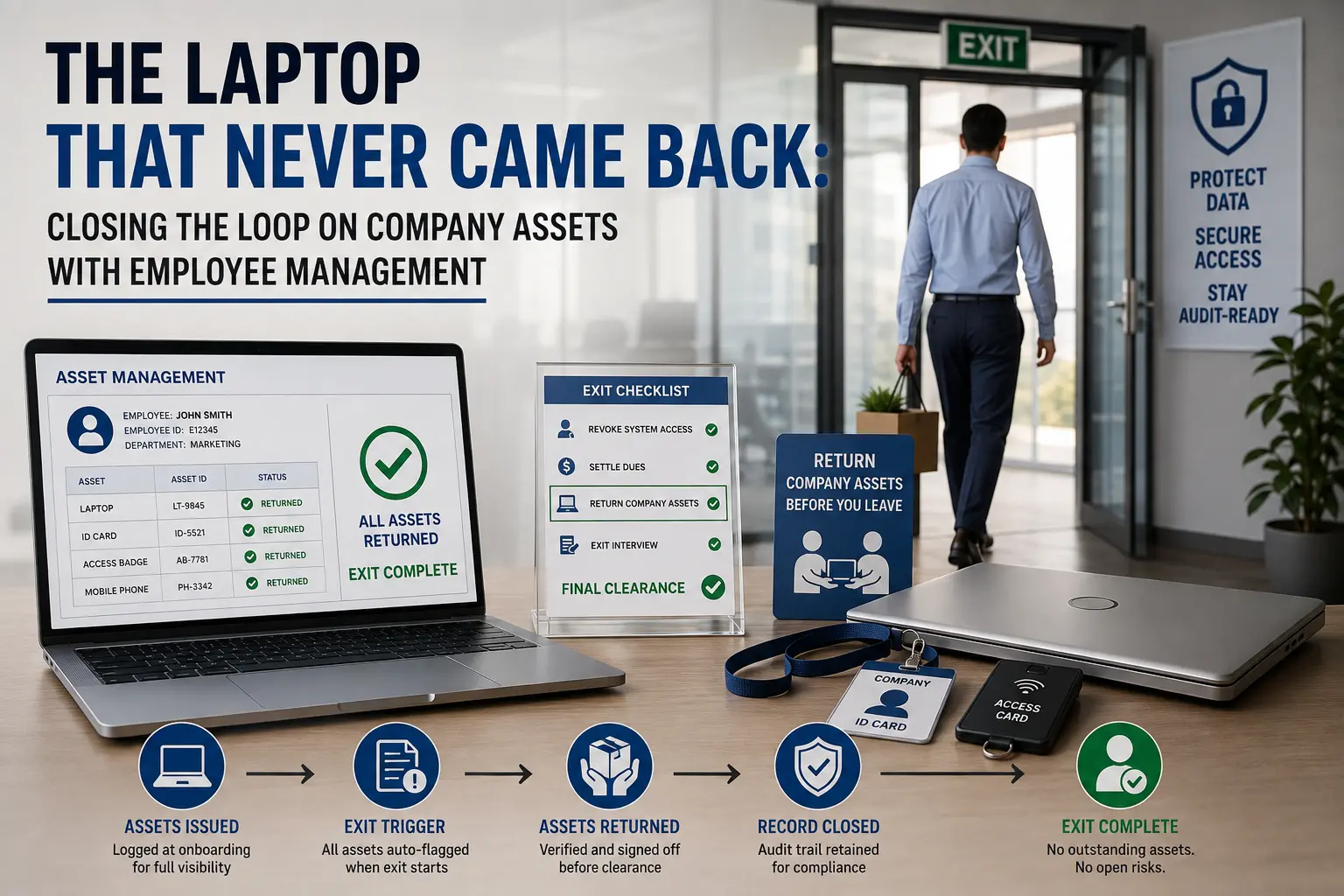
Employee management that stops at the exit interview leaves a gap: company laptops, ID cards, and access badges that never get returned. Closing that gap means treating asset recovery as a required, tracked step in the exit process, not a follow-up email sent after the person is already gone. A proper audit trail links every issued asset to the employee’s exit status, so nothing outstanding slips through. That protects company data, keeps physical access secure, and keeps the organization audit-ready.
An employee offboards, drops off their badge, and walks out the door. Four months later, an IT audit flags a missing high-end laptop, and a quick check of the records reveals it left with that very employee. Instead of being properly returned, the device sits forgotten in a drawer at home.
Sound familiar? What is the company supposed to do now?
Even the most organized HR teams know how easily hardware gets lost in the shuffle. Offboarding naturally focuses on exit interviews, final paychecks, and revoking system access, while physical assets end up treated as an afterthought. Assets don’t disappear because former employees are dishonest. They disappear because exits are handled as a quick checklist rather than an owned, tracked handoff. When no single person owns that final exchange, laptops, phones, badges, and other company assets quietly become someone else’s problem, until an inventory check catches the gap too late to matter.
This isn’t a minor administrative miss. Every unreturned laptop carries live data, and every active badge is a physical way into your building. What looks like a quiet oversight is actually a gaping security vulnerability masquerading as an office mix-up. Without accurate employee management and clean access control records, companies can’t say for certain what’s still out there or who still has access to what. Leaving physical recovery to chance undermines even the strongest digital defenses. Here’s what actually closes that loop.
Why Company Assets Get Lost in the Offboarding Shuffle
Company assets get lost during offboarding because exits are handled as a task list for HR and the departing manager, not as a system that tracks who has what. A checklist confirms a resignation letter was filed and a final salary was processed. It rarely confirms that every laptop, badge, and access card issued to that person has actually come back. That’s the core gap in most Employee Exit Process & Separation Management setups today.
Most companies don’t have one place where “this employee has these assets assigned” sits next to “this employee’s last working day is X.” Asset records sit with IT or admin. Exit records sit with HR. Nobody checks the two against each other before the employee walks out the door.
That gap is structural, not a training issue. It shows up in well-run HR teams almost as often as disorganized ones, because the systems involved were never built to talk to each other.
The Security and Compliance Exposure Behind an Unreturned Asset
The real risk with an unreturned laptop or badge isn’t the replacement cost. It’s what’s still on the device and what it can still open. A former employee’s laptop can hold client files, contracts, and saved logins long after their last day. A badge that’s never deactivated is a working key to your building.
This is exactly where a structured Employee Exit Process & Separation Management approach earns its place, because loose ends here turn into concrete exposure:
- Data security risk: Company files, emails, and saved credentials leave the building on a device nobody is tracking.
- Compliance and audit risk: Auditors ask for a list of company assets and who holds them. Unaccounted equipment is a finding, not a footnote.
- Physical access risk: Badges and key fobs stay active until someone remembers to switch them off, sometimes weeks after the person is gone.
Why This Gets Missed Even in Organized HR Teams
This isn’t about HR teams cutting corners. Asset tracking usually lives outside the HR system entirely, in a spreadsheet IT keeps or a shared folder admin manages. Without connected HR documentation management software, exit and asset records simply live apart. When an exit is initiated in HR, nothing automatically tells that separate system to flag the assets tied to that employee. The two processes run in parallel instead of together, and “exit complete” gets marked before anyone asks whether the assets came back.
Building an Audit Trail That Actually Closes the Loop
Closing the loop means building a record that follows an asset from the day it’s issued to the day it’s returned, tied directly to the employee’s exit status, not a reminder email sent after the fact and hoped for the best.
A working audit trail generally includes:
- Asset assigned and logged at onboarding, so there’s a starting record for every laptop, badge, or device issued.
- Exit trigger auto-flags all assets tied to that employee the moment offboarding starts, instead of relying on someone to remember.
- Return is confirmed and signed off before final clearance is granted, closing the record formally.
- Record retained for compliance and audit purposes, so the company can produce a clean history whenever it’s asked for one.
This is the difference between practicing sound Employee Management and simply hoping nothing slips through. Good HR documentation management software links every asset record to the employee file automatically, which is where a connected Employee Management System starts doing the job a spreadsheet never could.
Making Asset Return a Required Step in the Exit Process, Not a Follow-Up
This only works when asset recovery is built into the exit workflow itself, not left to whoever remembers to chase it down afterward. If returning a laptop or badge is optional, or dependent on someone’s memory, it will get missed eventually, no matter how careful the team is. That’s core to sound Employee Management at exit, not just at onboarding.
The modern Employee Asset Management module builds this directly into the exit process: assets assigned to an employee are automatically flagged the moment their exit workflow starts, and final clearance doesn’t complete until every item is accounted for. HR isn’t chasing equipment after someone has already left the building. The record exists before that becomes necessary.
The result is a faster, cleaner clearance process and an audit trail that holds up when someone asks for it. That’s what a functioning Employee Management System looks like in practice: not another feature to configure, but the natural next step once asset recovery is treated as part of the exit itself, not an afterthought bolted on when a laptop turns up missing.
Closing the Loop Is the Difference Between an Exit and a Liability
An exit only stays an exit when everything issued to that employee comes back and gets recorded. The moment a laptop, badge, or access card goes untracked, it becomes an open liability sitting outside the company’s control.
Fixing this isn’t about adding more steps to an already long offboarding checklist. It’s about shifting how exits are handled overall, from a list of tasks to a closed-loop process where asset status is as visible as exit status. Once Employee Management includes assets as a required part of the record, the gap that lets a laptop disappear for months simply doesn’t exist anymore.
FAQs
Why do company assets go missing during offboarding?
They go missing because exits are tracked as a task list, not a handoff. Asset records and exit records usually live in separate systems, so nothing confirms that everything issued to an employee has actually been returned before they leave.
How can HR teams track laptops, badges, and equipment through the exit process?
By linking every issued asset to the employee record at the point of onboarding and flagging it automatically the moment an exit begins. This keeps Employee Management connected to asset tracking instead of running the two as separate, disconnected processes.
Should asset recovery be a required step before final clearance, not optional?
Yes. Making it optional means it depends on someone remembering to follow up, which fails eventually. A clear Employee Exit Process & Separation Management structure requires signed-off asset return before clearance closes, so nothing outstanding slips through.
How is asset tracking different from revoking system access at exit?
Asset tracking covers physical items like laptops, badges, and equipment. Revoking system access covers digital permissions like logins and software accounts. Both need to happen at exit, but they’re separate checks, and neither one substitutes for the other.