





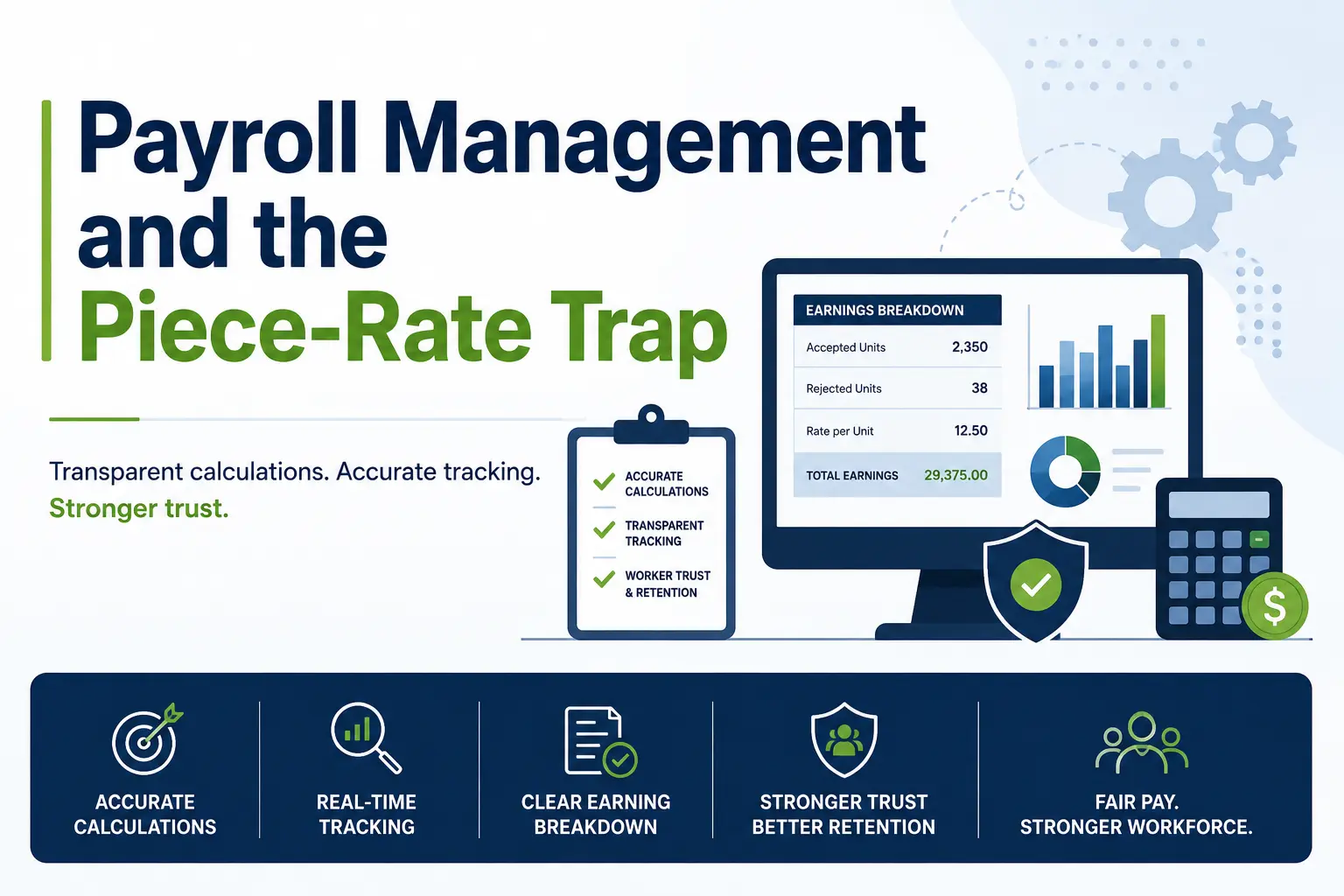
The biggest challenge in piece-rate payroll is not payment speed. It is employee trust. Effective Payroll Management combines transparent rate calculations, accurate production tracking, and clear earning breakdowns so workers understand exactly how every payment is calculated. This reduces disputes, improves retention, and creates a fair payroll experience across manufacturing, textiles, agriculture, and other production-driven industries.
Payday arrives right on schedule, yet your floor team is already queuing outside HR with questions. Supervisors spend precious hours cross-checking daily production logs while your administrative team scrambles to recount completed batches. On paper, your payroll execution was flawless and fast, but your staff still leaves feeling shortchanged. You might easily mistake speed for equity, assuming prompt payouts keep workers satisfied, but true workforce confidence demands total visibility into how every single unit converts into compensation.
Your organization faces immediate friction when team members cannot trace the math behind their paychecks. When people can’t verify their earnings against actual daily output, organizational trust erodes rapidly across the floor. Processing speed means very little if your workforce doubts the final numbers landing in their accounts. Effective Payroll Management balances flawless execution with complete calculation transparency, ensuring every worker clearly understands their true value.
Why Payroll Management Cannot Build Trust Without Transparency
Your payroll software can process thousands of line items in seconds, yet employees still feel underpaid when your calculation logic remains a complete mystery. Speed is simply an operational metric, whereas fairness is a psychological perception built on total visibility. High-volume production setups feature complex yield rules, variable rate schedules, and strict quality adjustments that confuse staff when delivered as an unitemized total.
Fast Payroll Does Not Always Mean Fair Payroll
Consider two operators on your main production line who work identical shifts. Operator A finishes 460 accepted units, while Operator B completes 455 units right alongside them. Both walk away expecting nearly identical paychecks at the end of the pay cycle. However, subtle quality adjustments and rejected unit deductions alter their final compensation, leaving both workers confused because neither can see the itemized breakdown. Trust begins long before payday arrives, and hiding calculation steps behind a single total payout only creates unnecessary friction.
Adams’ Equity Theory Explains Why Workers Notice Fairness Before Speed
Your workers constantly evaluate their compensation by weighing their physical effort and daily output against the rewards they see their peers receiving. When your team senses an imbalance between what they put in and what lands on their pay stub, motivation drops sharply, and friction spreads across the shop floor.
Perceived Fairness Shapes Retention More Than Payroll Speed
Your employees rarely make a fuss when a bank delay pushes pay delivery back by a few hours. Instead, they raise serious concerns when production tallies seem inconsistent, quality deductions appear arbitrary, or unit rates change without clear advance notice. Communicating the exact logic behind every payout protects workforce morale and stops operational friction before it turns into active turnover.
- Frequent compensation inquiries overwhelming your HR team
- Heated daily disputes between floor workers and shift supervisors
- Noticeable drops in daily output and product quality
- Unplanned absenteeism immediately following pay disbursement days
- Rising turnover among your most experienced production staff
Where Manual Piece Calculations Create Payroll Error
Manual tracking methods introduce constant human error into your production logs, creating deep suspicion among your team. Paper tally sheets, manual spreadsheet entries, and rushed shift handoffs routinely cause payroll errors that damage employee confidence. Manufacturing, textile, packaging, garment, and agricultural operations run this risk every single day when relying on manual systems.
Small Calculation Mistakes Become Large Trust Problems
Manual administrative workflows invite mistakes at every phase of your operational tracking. A single transposed number on a physical log sheet distorts an entire paycheck, leading to frustration. When your workers catch these arithmetic mistakes before your managers do, their faith in your leadership suffers a major hit.
Duplicate entries across shift sheets create immediate calculation errors. In contrast, incorrect unit totals logged during chaotic shift changes compound the confusion. Selection of outdated piece rates during batch entry, unrecorded rejected items, and formula bugs hidden inside administrative spreadsheets quickly lead to version confusion that ruins payroll accuracy across your operations.
How Piece-work Management Creates Payroll Transparency
Modern piece-work Management works as a comprehensive transparency system, bringing complete visibility to every calculation step for both managers and workers. This operational clarity transforms variable compensation from a frustrating black box into an easily verifiable record.
Every Piece Has a Visible Calculation
Automated tracking systems continuously log accepted units, rejected items, applied rates, and manager sign-offs as they happen on the floor. Your workers gain immediate insight into their exact line-item breakdown, removing all guesswork from payday. Clean, accessible recordkeeping resolves compensation questions before they ever escalate into formal complaints.
Shift leaders instantly verify total completed units, while the system clearly separates approved output from rejected pieces. Applicable rate rules automatically apply to every production run, displaying total earnings with detailed line-item breakdowns. Historical rate changes remain fully traceable for audit confidence, and manager sign-offs log with precise timestamps to maintain operational trust.
Transparency reduces unnecessary administrative conversations.
The Role of Payroll Management in HRM in Building Long-Term Workforce Trust
Integrating accurate payroll processing into your broader strategy for Payroll Management in HRM turns routine administrative tasks into a powerful engine for building workforce trust. Every single paycheck you distribute directly shapes how your employees perceive company leadership and operational fairness.
Transparent Payroll Supports Better HR Decisions
Clear calculation workflows protect your company culture while streamlining day-to-day administrative burdens. When your HR leaders spend less time resolving payout disputes, they can focus far more energy on improving operational efficiency and team development. Clean, reliable compensation data gives your business a dependable foundation for sustained growth.
- Fewer pay disputes escalating to management desks
- Stronger retention across skilled floor teams
- Clean, audit-ready compliance records for internal reviews
- More productive HR teams focused on strategic initiatives
- Stronger mutual trust between floor workers and leadership
Choosing Payroll Management In Hr That Supports Piece-Rate Operations
Selecting modern payroll management means looking far beyond simple salary automation. Complex, output-driven environments require specialized tools built specifically to handle variable rate structures, quality tiering, and detailed production tracking. When your platform seamlessly mirrors these complex shop-floor realities, choosing the right system comes down to prioritizing the specific features that drive total calculation accuracy.
Features That Matter Most for Piece-Rate Payroll
Your organization needs robust tools engineered specifically for dynamic calculations and real-time output tracking. Evaluating modern platforms requires a close look at specific operational capabilities that keep your floor running smoothly.
- Production-based calculation engines that update automatically
- Complete rate version histories for variable pay structures
- Detailed audit trails for every approved transaction
- Multi-level approval workflows built for shift managers
- Automated exception reporting for rate discrepancies
- Direct employee earning visibility through self-service portals
- Seamless integration with core operational modules
- Multi-location support for distributed production facilities
- Manufacturing-ready workflows designed for shift environments
- Flexible calculation rules that adapt to unique operations
Top cloud-based HR and payroll management solutions for enterprises and the best HR and payroll management software for small businesses deliver these crucial operational capabilities. You should always choose software based on your true operational complexity, not team size alone. Modern platforms provide fully integrated production tracking alongside automated compensation tools to guarantee precision across complex environments. Upgrading your systems transforms variable compensation into an open, transparent experience that earns workforce trust on every single payday.
Transparent Payroll Management Builds Lasting Worker Trust
The core issue in variable compensation is rarely how fast you process payments. It is whether your team actually trusts the math. Your workers place confidence in your business when every calculation is visible, easy to understand, and completely consistent across every pay period. Investing in modern Payroll Management helps you eliminate costly disputes, strengthen workforce confidence, and build an operational foundation that keeps your best people on the team for the long haul.