




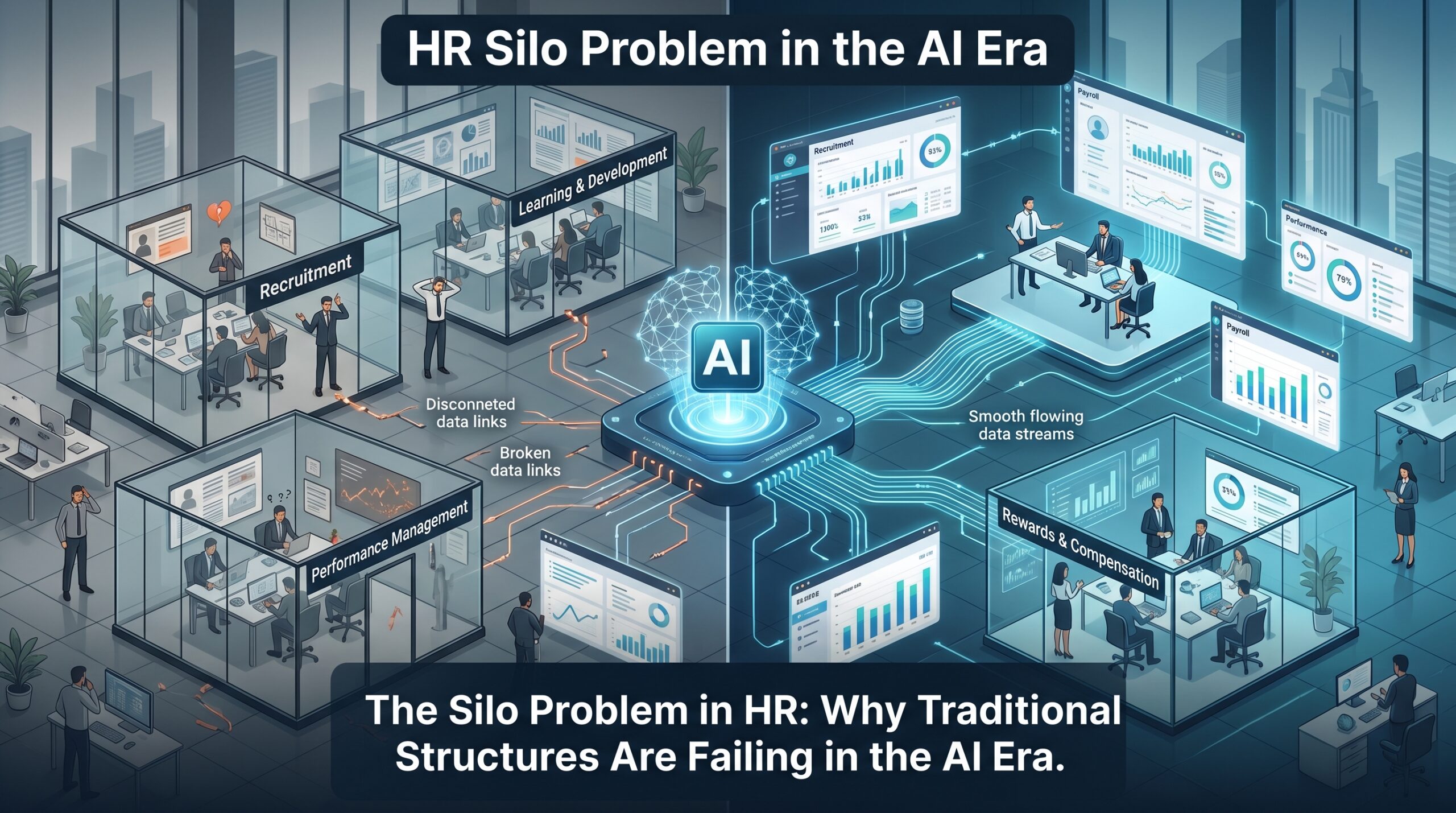
Most HR leaders are not struggling because they lack data, talent, or technology. They are struggling because the employee journey is fragmented across disconnected HR functions. Recruitment, learning, performance, and rewards often operate independently, creating gaps in visibility, slower decision-making, and missed opportunities to develop and retain talent. Walk into almost any HR department today, and you will see the same architecture: recruitment in one corner, learning and development in another, rewards and compensation down the hall, and performance management somewhere else entirely.
These silos have existed for decades. They seemed logical once. Specialization drove efficiency. Each function developed deep expertise. Handoffs between teams followed predictable sequences. But that world is gone.
The rise of AI is exposing something uncomfortable. Traditional HR structures organized around silos like recruitment, learning, rewards, and performance are not just inefficient anymore. They are actively undermining the value HR can deliver.
In an AI-powered work environment, fragmentation is fatal. AI thrives on connected data. When employee information lives in disconnected silos, no single view connects the dots. Value follows workflow redesign, not tool count. And most organizations have not done the redesign work.
What Exactly Is the Silo Problem?
The silo problem is the structural fragmentation of HR into disconnected functions that operate independently, share data poorly, and create inconsistent employee experiences.
Every day, employees navigate this fragmentation. They submit leave in one system. Log learning hours in another. Receive performance feedback through a third party. Recruitment does not talk to learning. Rewards do not see performance data until months later.
The problem persists for three core reasons.
First, legacy organizational design. Most HR departments were built around functional specialization. Recruitment is reported to one leader. Learning from others. These rigid boundaries created friction, not efficiency.
Second, fragmented technology systems. An applicant tracking system here. A learning platform there. A separate payroll tool somewhere else. Each works in
isolation, but together they prevent holistic workforce analytics.
Third, outdated performance models. Annual reviews and rigid career ladders belong to a different era. AI demands real-time feedback and skills-based mobility. Organizations clinging to old models are losing their best talent.
This is the silo problem. And it is the single greatest barrier to strategic HR in the AI era.
The High Cost of Staying Fragmented
When HR operates in silos, the consequences cascade across the organization. Employee experience breaks down because no single team owns the whole relationship. Decision-making stalls as data moves too slowly from recruitment to learning to performance.
AI investments consistently underperform without proper workflow redesign. Companies spend millions on AI tools but see little return because fragmented structures prevent access to connected data. HR’s strategic credibility erodes as business leaders build their own talent solutions instead of trusting HR.
The cost shows up daily in rising turnover, falling productivity, and missed growth opportunities. These are not abstract problems. They hit the bottom line directly.
Closing the Gap Through Technology
The solution is not working harder inside silos. It is dismantling the silos themselves.
Organizations that successfully execute HR strategy in this technology era share three traits:
- Centralized, real-time workforce data
- Automation of transactional work
- Integrated platforms that collapse functional boundaries
A robust Human Resource Management System closes the silo problem through
Four mechanisms:
- Centralized single source of truth: No more spreadsheet chaos or disconnected systems.
- Automated cross-functional workflows: When an employee completes training, performance records update automatically, resulting in no manual handoffs.
- Real-time analytics and dashboards: One live dashboard shows recruitment, learning, performance, and engagement together.
- Unified employee experience: One portal for leave, learning, pay, and performance.
The Right HRMS Solution for a Connected Future
For organizations ready to move beyond fragmented structures, a modern Human Resource Management System delivers the innovation needed to redesign HR for the AI era. It is not just another tool. It is a complete solution that transforms how HR operates.
A comprehensive HRMS covers the entire employee journey with fully integrated modules. These include manpower planning, recruitment, onboarding, attendance, payroll, performance, and training management, working together seamlessly from day one. Every module shares data with every other module, eliminating the handoffs that once caused friction and delay.
With robust mobile accessibility, every HR function lives in employees’ pockets. Voice-enabled features allow clock-in, leave requests, and policy access hands-free from anywhere. Customizable dashboards provide instant visibility into every workforce dimension, showing recruitment, attendance, performance, learning, and payroll data together in unified views.
Decision-making shifts from fragmented guessing to connected intelligence as leaders finally see the complete picture instead of isolated snapshots. A quality HRMS serves companies of every size and scales smoothly from small teams to large enterprises without creating new silos or losing functionality.
Your Blueprint for Dismantling HR Silos
Audit your current structure and map every employee touchpoint. Identify where data breaks.
Pilot cross-functional teams focused on outcomes like onboarding quality or retention. Integrate your technology and partner with IT to unify data.
Redesign roles for outcomes and train your team for systems thinking. Align every AI rollout with structural integration, not fragmentation.
The Future of HR Is Connected, Not Siloed
The traditional HR model built on silos is misaligned with how AI operates and how work gets done today.
You already know the symptoms. Disconnected experiences, fragmented data, and stalled decision making. The question is whether you will change before your competitors do. Every day you wait, the fragmentation worsens.
Those who rewire HR for agility will win the talent war. FlowHCM makes this redesign possible by transforming disconnected functions into a connected strategic ecosystem. The silos are falling. The only question left is whether you will lead that transformation.